AI Agents: More Than a Chatbot (And Why You Need Them)
 Erwin Berkouwer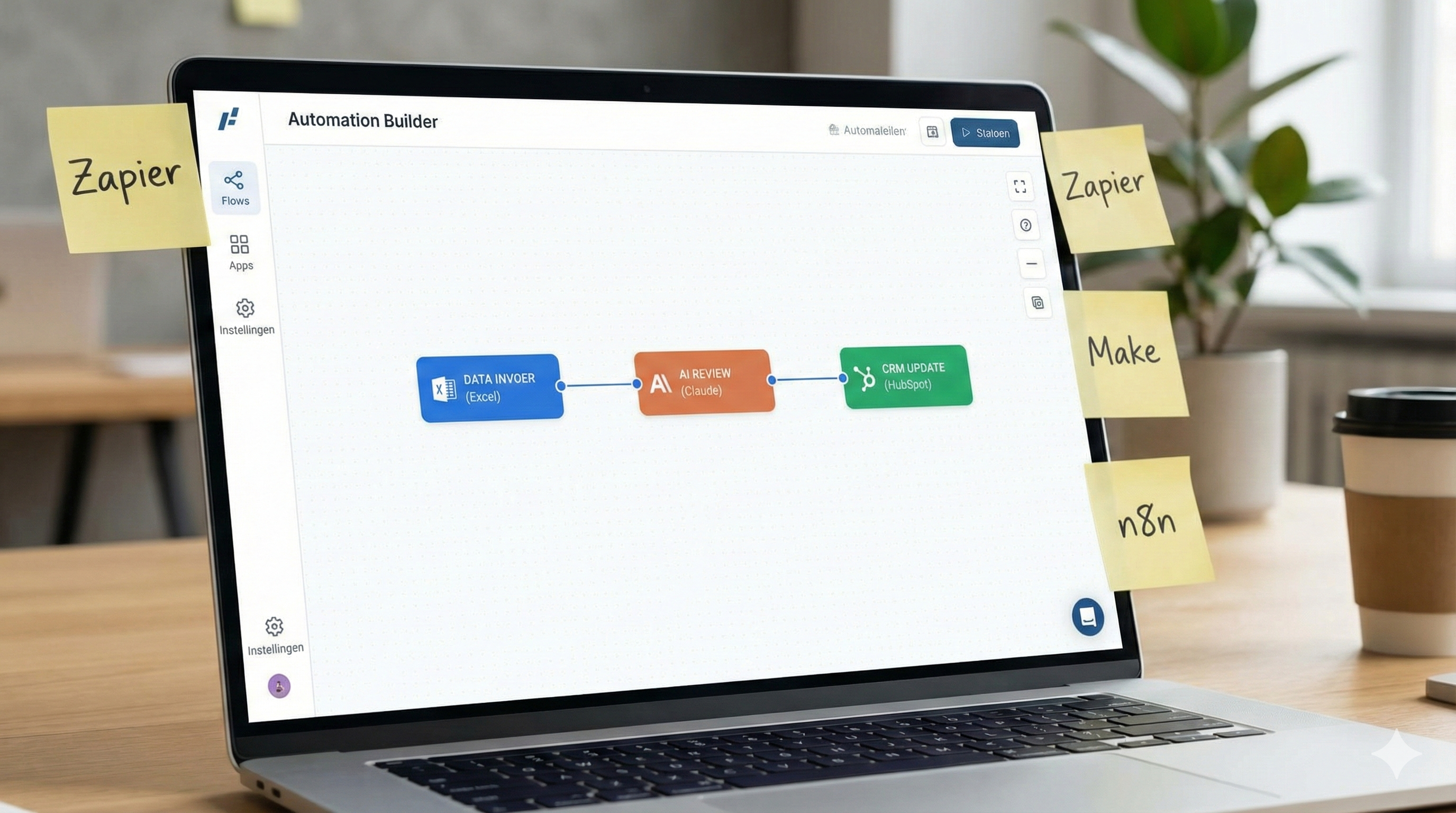
Everyone knows ChatGPT, but AI Agents are the next step. Discover how these autonomous systems not only talk, but actually do real work in your business.
Every hour your team spends retyping invoices, looking up delivery times, or answering standard questions costs you an average of €35 in labor costs. Companies that switch to AI agents save up to 15 hours per employee per week — companies that wait simply keep paying that price.
What is an AI agent?
An AI agent is software that independently executes tasks, makes decisions, and works with your existing systems — without you having to direct every step. Think of a digital employee with a job description: they plan, take action, and report.
The difference from ChatGPT is simple: ChatGPT waits for you to write. An AI agent gets to work without you needing to be involved. Learn more about the possibilities on our AI agents page.
Examples of what an AI agent does:
- A customer emails about their order → the agent checks the system, responds, and closes the ticket
- A PDF invoice arrives → the agent recognizes the supplier, matches it with the purchase order, and books it in your accounting package
- A prospect fills out a form → the agent qualifies the lead and schedules a meeting with your account manager
Why an AI agent goes further than a chatbot
A chatbot follows a script. Ask it something not in the script, and it says "I don't understand."
An AI agent reasons. It understands context, combines information from multiple systems, and takes action.
| Chatbot | AI Agent | |
|---|---|---|
| How it works | Responds to questions | Executes tasks |
| Decisions | Follows fixed paths | Reasons independently |
| Systems | 1 channel | Connects with multiple tools |
| Availability | 24/7 | 24/7 |
| Adaptation | Manual script updates | Learns from interactions |
| Implementation costs | €500–€5,000 | €2,000–€10,000 |
What do the numbers say?
- A Dutch webshop had an AI agent independently handle 52% of all customer questions
- Average handling time dropped from 14 minutes to 2 minutes
- Companies deploying AI agents report an average of 300% ROI within 12 months
How Unify AI does it
At Unify AI, we build AI agents that integrate with what you already use. Not replacing your systems, but a smart layer on top.
We connect agents to tools that SMEs know:
- Email and calendar: Outlook, Gmail, Google Calendar
- Administration: Exact, AFAS, Visma
- CRM and sales: Salesforce, HubSpot, Pipedrive
- Data and documents: SharePoint, Google Drive
See our integrations for the complete overview. We always start small: one process, one agent, measurable result. Then we expand. Check out concrete use cases from companies like yours.
All agents run on secure environments. Your data is not used to train public AI models.
Concrete benefits (ROI and time savings)
| Application | Time savings | Cost savings |
|---|---|---|
| Customer service automation | 70% fewer manual tickets | 20–30% lower service costs |
| Administration (invoices, orders) | 3–5 hours per week per employee | €500–€2,000 per month |
| Lead qualification | 80% less preparation time | More revenue per account manager |
| Document processing | From 14 min to 2 min per document | Scale without extra staff |
Calculate what an agent will deliver for your business using our ROI calculator.
Frequently asked questions
What exactly is an AI agent?
An AI agent is software that independently executes tasks: reading emails, consulting systems, making decisions, and answering customers — without you directing every step. It's more than a chatbot because an agent acts, not just talks.
How much does it cost to implement an AI agent?
Implementation costs start around €2,000 and go up to €10,000 for more complex setups. Most companies earn this back within 3 to 6 months. On average, an AI agent delivers 300% ROI within 12 months.
Does my business need technical knowledge?
No. Unify AI handles the technical implementation and integration with your existing systems. You describe the process, we build the agent. After implementation, you give instructions via a simple dashboard — no coding required.
What's the difference between a chatbot and an AI agent?
A chatbot follows a fixed script and only responds to direct questions. An AI agent understands context, connects with multiple systems, and independently executes complete tasks. An agent closes a ticket; a chatbot only gives an answer.
Which industries are AI agents suitable for?
AI agents work well in industries with lots of repetitive customer contact, administration, or data processing: transport, e-commerce, business services, construction, and healthcare. Check our use cases by sector for concrete examples.
Ready to put an AI agent in your business?
We always start with one concrete process. In a free demo, we'll show you exactly how an agent works for your situation.