CRM Automation with AI: Stop Manually Updating Records
 Erwin Berkouwer
Sales teams waste an average of 5.4 hours a day on manual CRM work. AI takes that over — so your sales team focuses on deals, not data entry.
Sales teams in the Netherlands waste an average of 5.4 hours a day maintaining their CRM. They type notes after each call, copy data from emails into HubSpot or Salesforce, and manually set reminders for follow-up. Meanwhile, the deals that actually generate revenue are waiting.
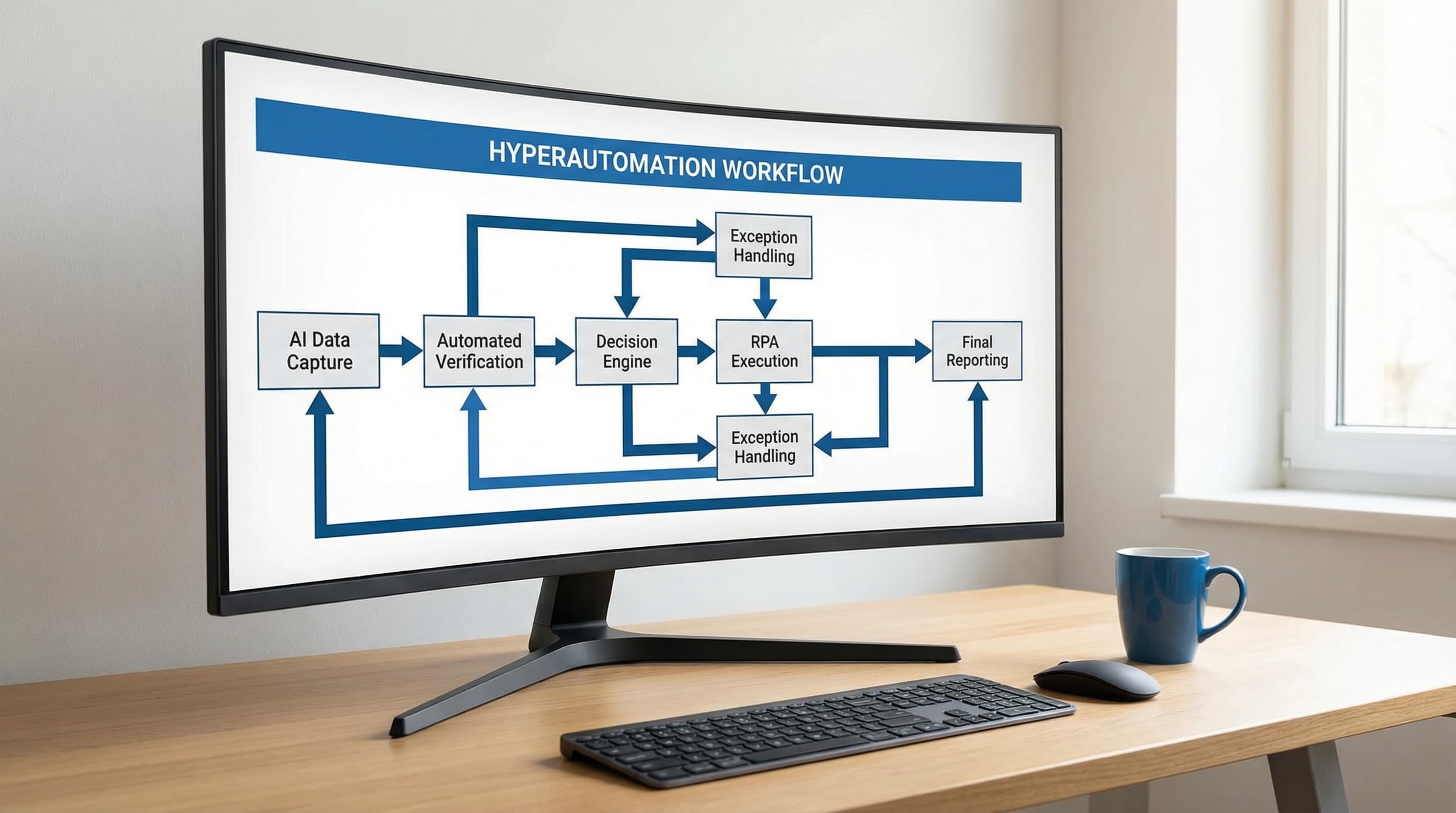
AI puts an end to this pattern. Not with a glossy dashboard or vague promises, but with concrete automation that keeps your CRM updated while you sell. This article explains how it works, what it delivers, and how you start in four steps.
The good news: you don't need to replace your existing CRM. AI works as a layer above your current system — whether that's HubSpot, Salesforce, Pipedrive, or AFAS. In most cases, the integration goes live within two to four weeks, and ROI is visible from the first month.
Why Your CRM Now Costs More Than It Delivers
A CRM system is designed as a sales tool. In practice, for many SMB sales teams it's an administrative nightmare. Every lead requires manual entry. Every call needs a note. Every quote wants a status update. The result: salespeople spend more time in the system than with customers.
The costs of this manual work are concrete. With a sales team of five people each spending three hours a day on CRM administration, you lose 75 productive hours per week. At an average hourly rate of €45, that's more than €175,000 a year of work that generates no revenue.
That's not even the biggest problem. CRM data quickly becomes outdated when manually maintained. Phone numbers no longer work, contacts have moved on, deals sit at the same status for months. Decisions based on outdated data lead to missed opportunities and faulty forecasts.
Expert tip: Salesforce research shows that 32% of salespeople spend more than three hours a day on non-selling tasks. The biggest time waster is data entry in the CRM.
What AI Concretely Does in Your CRM
AI-CRM automation works on three levels. The first level is automatic data entry: AI reads your emails, meetings, and conversations and automatically translates them into CRM updates. No manual notes after a sales call — the AI writes the summary, links it to the right contact, and sets the follow-up action.
The second level is intelligent lead qualification. AI analyzes lead behavior — which pages they view, how they respond to emails, how long deals have been open — and automatically assigns a score. Your sales team immediately sees which leads are ready for a conversation and which need more nurturing.
The third level is predictive pipeline management. AI predicts which deals you'll win and which are at risk of stalling. Based on response times, communication frequency, and historical patterns, the system flags risks before a deal is lost.
The Difference Between Native AI and Custom AI Agents
Here's a crucial insight that most articles about CRM and AI miss. There's a big difference between the built-in AI features of your CRM (like HubSpot's Content Assistant or Salesforce Einstein) and a custom AI agent that works on top of your CRM.
Native CRM AI is limited to the system itself. It can suggest text or assign scores within HubSpot. But it has no access to your inbox, your accounting package, or your customer service platform.
A custom AI agent transcends those boundaries. Such an agent can:
- Read an email in Outlook, identify the lead, update HubSpot and schedule a follow-up message
- Link an invoice in Exact Online to a CRM deal and adjust relationship status
- Receive a customer inquiry via Trengo, retrieve customer history from your CRM and send a personalized response
- Retrieve Chamber of Commerce data to automatically enrich new contacts with company information
For SMBs with multiple systems — accounting package, email platform, CRM, customer service software — a custom AI agent delivers significantly more value than the built-in AI of any single platform.
Practical Applications with ROI Figures
| Application | Time Saved | Investment | Payback Period |
|---|---|---|---|
| Automatic email-to-CRM logging | 8-10 hours/week | €3,000-€5,000 | 6-8 weeks |
| AI lead scoring and qualification | 5-8 hours/week + 35% higher conversion | €4,000-€7,000 | 8-12 weeks |
| Predictive deal monitoring | 40% fewer lost deals | €6,000-€9,000 | 3-5 months |
| CRM data enrichment via Chamber of Commerce and LinkedIn | 3-5 hours/week | €2,000-€4,000 | 4-6 weeks |
| Automatic quote notifications | 2-4 hours/week | €1,500-€3,000 | 3-5 weeks |
Automatic Email-to-CRM Logging
The most direct time savings is in automatically processing emails. AI reads incoming and outgoing messages, recognizes contacts and companies, and logs the communication directly in the right CRM file. Conversation summaries, sentiment analysis, and action items are automatically added.
With an average sales team, this delivers 8 to 10 hours of savings per week per employee. Across a team of five people, that's 40 to 50 hours per week — more than one full-time employee.
An additional benefit: the quality of CRM data immediately improves. Because the AI logs every interaction — including the exact date, channel, and content — the customer history is always current. Sales managers see at a glance the most recent contact points, open actions, and conversation sentiment. That makes coaching conversations more concrete and pipeline reviews faster.
Chamber of Commerce Link: Hidden Time Savings for SMEs
This is an application that most articles about AI and CRM completely overlook: the direct link with the Dutch Chamber of Commerce registry. When a new contact enters your CRM, an AI agent automatically retrieves the associated Chamber of Commerce information: legal form, SBI code, business addresses, number of employees, and official contact information.
That means your sales team never enters a conversation with incomplete customer information. And it means your CRM automatically stays segmented by company size, industry, or region — without manual searching or filling in. For SMBs doing prospecting in specific niches or regions, this is a direct time savings of three to five hours per week.
Predictive Deal Monitoring: Sealing Hidden Revenue Leaks
Many sales managers only realize a deal is lost after the customer has already chosen a competitor. AI-driven pipeline monitoring changes that. The system continuously analyzes signals of stalling deals: no response to the last three emails, deal has been open longer than average in the sector, the decision maker was involved but then disappeared.
With an average SMB with twenty active deals in the pipeline, an average of 35% are lost due to lack of follow-up or late detection. AI-driven monitoring reduces that by 40%, which with an average deal value of €15,000 quickly means tens of thousands of euros of additional revenue per quarter.
Expert tip: Combine predictive deal monitoring with an automatic escalation route. If a deal stays at the same status for more than two weeks, the system automatically sends a notification to the sales manager and schedules a reminder task.
GDPR and Data in Your CRM: What You Need to Know
A topic that most CRM-AI articles for Dutch companies completely overlook: the GDPR implications of AI in your CRM. This is not straightforward, especially if you work with US platforms like HubSpot or Salesforce.
The core question is: where is your customer data processed? Many built-in AI features in US CRM platforms process data on servers outside the EU. That violates GDPR unless you take additional measures, such as Standard Contractual Clauses or a Data Processing Agreement with explicit EU data residency provisions.
The same rules apply to a custom AI agent. If you work with a Dutch AI partner, you ensure that processing takes place on EU servers and that there is a processing agreement. That's not only legally required — it's also a selling point toward customers who ask questions about your data policy.
Practical GDPR Checklist for CRM AI:
- Ask your CRM provider about the data location of AI features
- Sign a Data Processing Agreement with both your CRM platform and your AI partner
- Document what purposes customer data is processed by AI for
- Set it so AI models are not trained on your customer data — most platforms offer this as an opt-out
Get Started in Four Steps
Step 1: Map Your CRM Time Waste
Before you implement AI, you know where the time goes. Have your sales team track for one week how much time they spend on manual data entry, looking up customer information, status updates, and scheduling follow-ups. That gives you a baseline and makes the ROI of automation concrete.
Step 2: Choose Your Starting Point
Start with the biggest time waster, not the most complex application. For most SMB sales teams, that's email-to-CRM logging. It's quick to implement — two to three weeks — immediately visible to the team, and delivers concrete ROI within six weeks.
Step 3: Choose Your Approach
If you work with HubSpot or Salesforce and your processes are relatively simple, start with the built-in AI features. They're low-barrier and require no additional technical implementation. If you work with multiple systems — Exact Online, AFAS, e-Boekhouden, or Trengo — then a custom AI agent makes sense. That requires a partner who builds both the CRM integration and the AI layer, but delivers significantly more.
Step 4: Measure After Six Weeks
After six weeks, measure again: how many hours does the team save? How has data quality in the CRM changed? Have more deals been won? Those figures are your business case for the next step — or for convincing skeptical leadership.
Expert tip: Set three concrete KPIs at the start: time saved per employee per week, percentage of CRM records fully filled in, and pipeline conversion rate. That makes the value of AI measurable and defensible.
Which CRM Provides the Best Foundation for AI?
| CRM | Native AI | Integration Options | GDPR Readiness |
|---|---|---|---|
| HubSpot | Strong (AI writing assistant, lead scoring) | 1,000+ connectors | EU data location available |
| Salesforce | Strong (Einstein AI, full platform) | Extensive, enterprise-focused | EU data location available |
| Pipedrive | Limited | Good via Zapier and Make | EU servers by default |
| AFAS CRM | Limited native AI | Strong for NL integrations | Fully NL, GDPR compliant |
| Trengo | Limited | Strong for customer contact | EU servers by default |
For SMBs focused on Dutch accounting software, AFAS is a logical choice for back-office integration. For a sales-focused environment, HubSpot is the strongest option for native AI, but requires extra attention to GDPR compliance in the AI modules.
Your CRM Works for You, or You Work for Your CRM
CRM automation with AI is no longer a luxury for large companies. It's a concrete, measurable investment that most SMB sales teams recoup within three to six months. The difference isn't in the technology — it's available. It's in the decision to start.
Sales teams switching to AI-driven CRM processes now keep their competitor a year ahead. Those other sales teams meanwhile keep manually typing notes. That's the difference between a sales team that's time-poor on administration and one that invests time in closing deals.
Want to know what AI can deliver for your company? Schedule a free conversation at unify-ai.nl/contact.