Why Your Chatbot Is Dumb (And How AI Does It Better)
 Erwin Berkouwer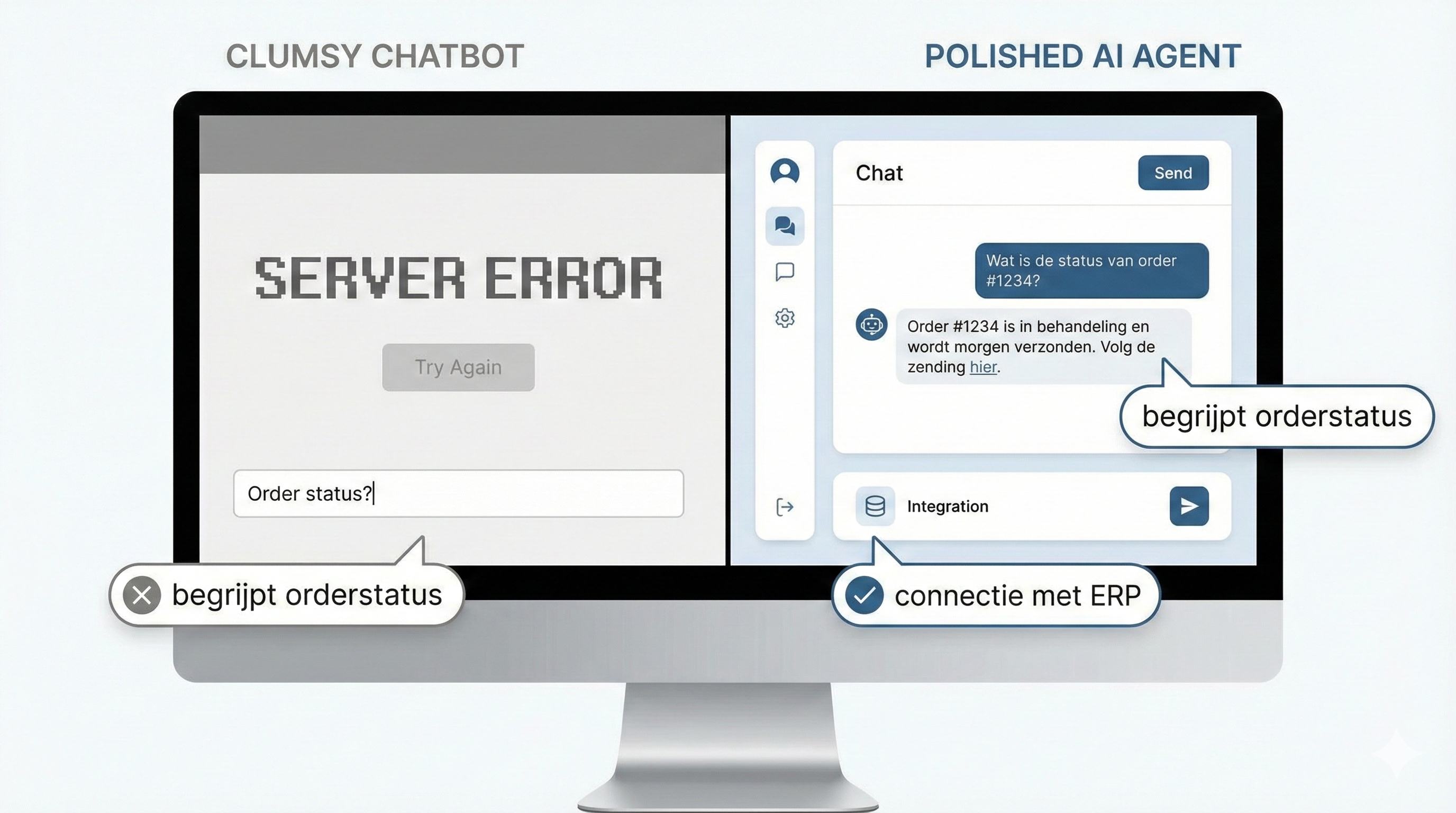
Chatbots answer only 1 in 8 questions correctly. Discover why your chatbot is driving customers away — and how an AI agent reverses that.
Your chatbot is on the website, it seems to work, and yet your customer service team complains they have to handle even more questions. That's correct. Chatbots solve an average of only 1 in 8 questions correctly. The other 7 end in frustration, a live chat, or a customer who drops off.
In 2026, 42% of Dutch consumers are frustrated with automated customer service — a 4 percentage point increase from last year. Companies that continue to rely on their "working" chatbot are quietly losing customers to competitors who have moved further ahead.
This article explains in clear terms why a chatbot structurally falls short — and what an AI agent does differently.
What makes a chatbot "dumb"?
A chatbot operates on scripts and decision trees. It recognizes keywords, looks up a matching response in its database, and returns it. That works fine if the customer asks exactly what you expect.
The problem: customers rarely do.
They ask questions that aren't in the script. They have a combination question ("I want to modify my subscription and request an invoice"). Or they have context that the chatbot doesn't have — because it doesn't know who the customer is, what they previously purchased, or what changed in your system yesterday.
A traditional chatbot has no memory, no access to your systems, and no ability to reason. It reads from a cheat sheet that you wrote once. The moment the situation deviates, it fails.
Rule of thumb: If more than 20% of your chatbot conversations end with "I'm connecting you to an agent," your chatbot isn't solving the problem — it's relocating it.
Why 1 in 8 questions goes wrong
Research shows that chatbots in the Dutch market solve an average of only 12.5% of customer questions correctly. The reason isn't that the technology is bad — it's that chatbots are fundamentally built for a world of simple, predictable questions.
Here's what goes wrong with the 87.5% that doesn't work:
| Reason | Share |
|---|---|
| Question outside the script | ~35% |
| Customer uses different words than expected | ~25% |
| Multi-step request that chatbot cannot combine | ~20% |
| Chatbot lacks backend integration (CRM, ERP) | ~17% |
Every time your chatbot fails to help a customer properly, it costs an average of €4.50 in additional handling time when the question moves to an agent — plus the risk that the customer leaves.
With 100 chatbot conversations per day, 250 workdays per year, and an 87.5% failure rate, you're talking about nearly 22,000 failed conversations per year. At €4.50 each, that's €98,000 in hidden costs — not counting customer churn.
How an AI agent approaches it differently
An AI agent doesn't operate on scripts. It understands the intent behind a question, queries your systems in real time, and can perform multiple steps in a row without agent involvement.
The difference in practice:
| Situation | Chatbot | AI Agent |
|---|---|---|
| Customer wants to modify subscription | Sends FAQ link | Looks up customer profile, makes change directly, sends confirmation |
| Question about a specific invoice | "I don't understand, please try again" | Queries your accounting system, provides invoice details |
| Combination question about shipping + return | Chooses one topic, ignores the rest | Answers both parts, processes return request directly |
| Customer calls outside office hours | Responds with office hours | Solves question completely, logs action in CRM |
Key distinction: a chatbot talks. An AI agent acts.
Concrete benefits for your business
Companies that switch from a chatbot to an AI agent see an average within 12 months:
- 68% decline in agent handoffs
- 300% ROI on investment through cost savings and higher customer satisfaction
- 4.2 hours per week less manual work per customer service employee
- 22% higher customer satisfaction (NPS improvement)
These aren't theoretical numbers. This is what happens when you stop relocating problems and start solving them.
When to choose what?
Not every business needs an AI agent right away. Here's a fair assessment:
| Situation | Chatbot Sufficient | AI Agent Better |
|---|---|---|
| Answer FAQ questions only | ✓ | |
| Look up and process customer data | ✓ | |
| Automate multi-step processes | ✓ | |
| 24/7 customer service without agents | ✓ | |
| Budget under €500/month | ✓ | |
| CRM/ERP integration needed | ✓ | |
| Scale without hiring more staff | ✓ |
If you check more than three boxes in the right column, your chatbot is already costing your business money.
How Unify AI solves this for you
At Unify AI, we build AI agents for SMEs — from 10 to 200 employees — that integrate directly with your existing systems. No multi-year IT projects, no new platform rollout.
Our agents work with tools you already use: your CRM, your scheduling software, your accounting system. They're configured for your processes, in Dutch, for your customers.
On average, our customers go live with a working AI agent within 6 weeks.
Ready to see what an AI agent can do for your business?
Frequently Asked Questions
What's the difference between a chatbot and an AI agent?
A chatbot operates on fixed scripts and decision trees. An AI agent understands context, queries systems, and executes multiple steps without human intervention.
My chatbot works fine — why upgrade?
A chatbot works fine for simple FAQs. With 42% of customers already frustrated with automation, that chatbot is costing you customers rather than retaining them.
What does an AI agent cost?
On average €2,000–€5,000 per month, with an average return of 300% ROI within 12 months.
Is this for small businesses too?
Yes. Unify AI specifically works with SMEs of 10–200 employees. No IT department required.
What if the AI agent doesn't know the answer?
It escalates to an agent with full context — so the customer doesn't have to repeat the story.