
AI policy and governance
Agreements on AI your whole organisation can follow.
Your organisation already uses AI, including tools you do not know about. In a workshop and a policy we lay down what is allowed, which data goes where and who approves. That way your organisation moves on with AI and the board keeps the overview.
- From
- € 2,450 one-off
- Pillars
- Strategy and Governance
- First step
- free
AI policy
Example
- AllowedSummarising texts and writing drafts in the AI workplace.
- Not allowedPutting customer data into a personal ChatGPT account.
- Who approvesA quote from an agent: the salesperson. Above € 10,000 the board as well.
- In case of an incidentReport it to the privacy contact the same day.
Two pages, in plain language, adopted by the board.
Why you arrange this now.
Three reasons that play in almost every organisation.
Shadow AI
Employees use ChatGPT and other tools on their own account. Then you do not know which customer data ends up where.
The EU AI Act
The law asks that whoever works with AI knows enough about it (AI literacy, article 4, since February 2025) and that it is visible when something was made by AI.
Who decides
An agent prepares work. Who approves, up to which amount and what happens after a mistake? Without an agreement everyone decides for themselves.
What you get.
A policy your team reads in ten minutes and an agent keeps to.
A workshop with the board and management
We go through what your organisation uses now, where the risks are and what you want to allow.
Your AI policy
What is and is not allowed, which tools, which data never goes into a model and what you do after an incident. In plain language.
Roles and approval
Per kind of work who approves. We also put those agreements in AgentWorks, so an agent follows them and everything is in a log.
An overview of your AI applications
Which tools and agents there are, what for and with which data. The basis for every question from a customer or a regulator.
From € 2,450 one-off, for the workshop and the policy.
How your agreements stand in AgentWorks.
A policy on paper only helps when the work actually follows it. What you agree on approvals and on which AI you use, we set up in the platform.
When an employee approves
- Looking up and reading dataRuns by itself
- Sending an email to a customerAn employee approves
- Posting a booking in ExactAn employee approves
- Sending a quote above € 10,000Two employees approve
Register of your AI systems
- Agent: booking purchase invoicesFinanceNot high-risk
- Agent: answering customer questionsCustomer serviceNot high-risk
- Workflow: sorting job applicationsHRHigh-risk
- Chat with the Company BrainAll teamsNot high-risk
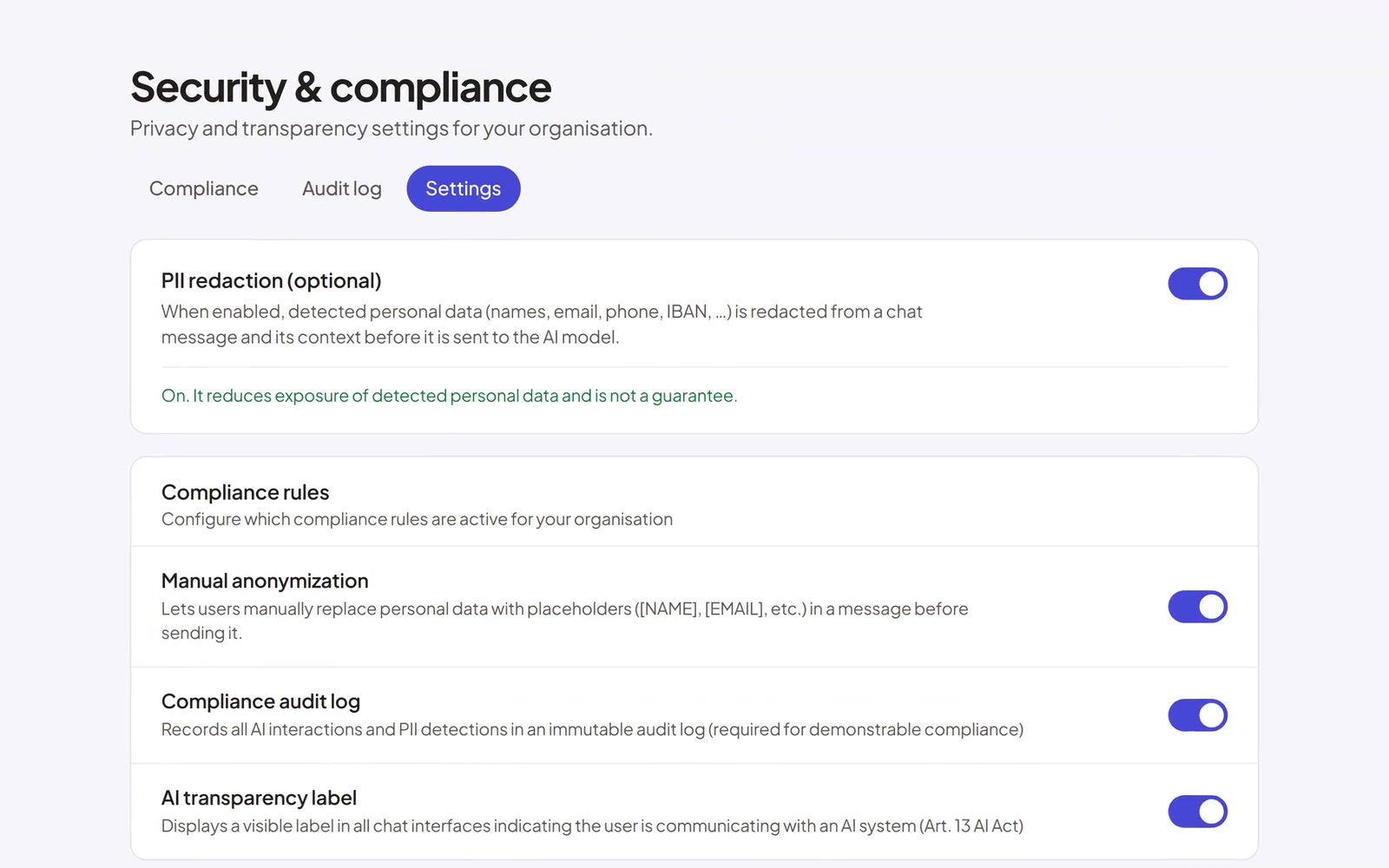
A privacy layer when you turn it on
When it is on, personal data it recognises can be masked before a model sees it. Off by default and not a guarantee.
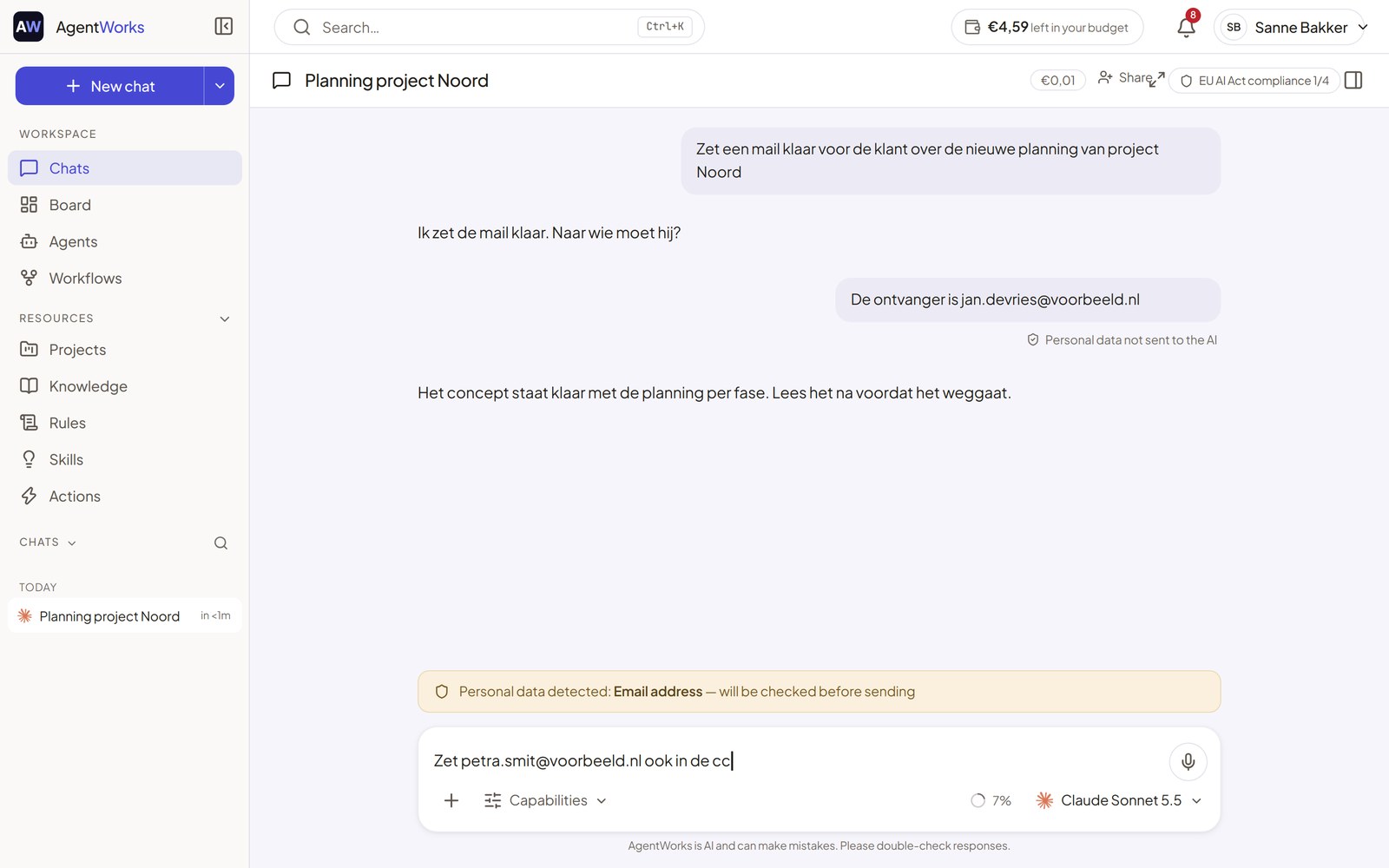
Visible in the chat
When the layer is on, the chat shows which personal data was recognised and is not sent to the model.
This is what it looks like in AgentWorks: rebuilt screens with example data.
How it goes.
From a first picture to an adopted policy.
- 1
Research what your organisation uses
With the free AI policy generator: an anonymous questionnaire of two weeks. You get the outcome and a first version of your policy.
- 2
Workshop
With the board and management we make the choices: what is allowed, who approves and what you do first.
- 3
Adopt and introduce
The policy is ready to adopt. The agreements on approval are in AgentWorks and your team gets a short explanation.
Start today, free. Open the AI policy generator
EU AI Act, GDPR and ISO 42001.
What we do and what we do not promise. We do not give legal advice for your situation.
EU AI Act
The policy covers AI literacy, visibility of AI and an employee who approves where it matters. Whether an application falls in a heavier category is a question for your lawyer.
GDPR
Which personal data a tool or agent may see and where it is processed. If we process it, that is laid down in a data processing agreement.
ISO 42001
The international standard for managing AI. Your policy gets the parts the standard asks for: policy, roles, risks and an overview. It is not a certificate.
Questions about AI policy.
What is an AI policy?
A document in which an organisation lays down how employees may use AI: which tools, with which data, who approves and what happens after a mistake.
Is an AI policy mandatory?
The EU AI Act asks organisations that use AI to make sure their employees know enough about it (AI literacy). A policy is the usual way to lay that down, with the agreements around it. Which obligations apply to you exactly depends on what you do with AI.
What is shadow AI?
AI tools that employees use without the organisation knowing or having agreements about them, often on a personal account.
Can I start without paying?
Yes. The AI policy generator is free: your team fills in a questionnaire anonymously and you get the outcome and a first version of your policy.
Does this belong to an AI transformation?
It can be bought on its own. In an AI transformation it is the building block for the pillars Strategy and Governance.
Shall we lay down your agreements on AI?
Book an advice session, or start free with the AI policy generator.