From LLM to Agentic AI: The Complete Framework
 Erwin Berkouwer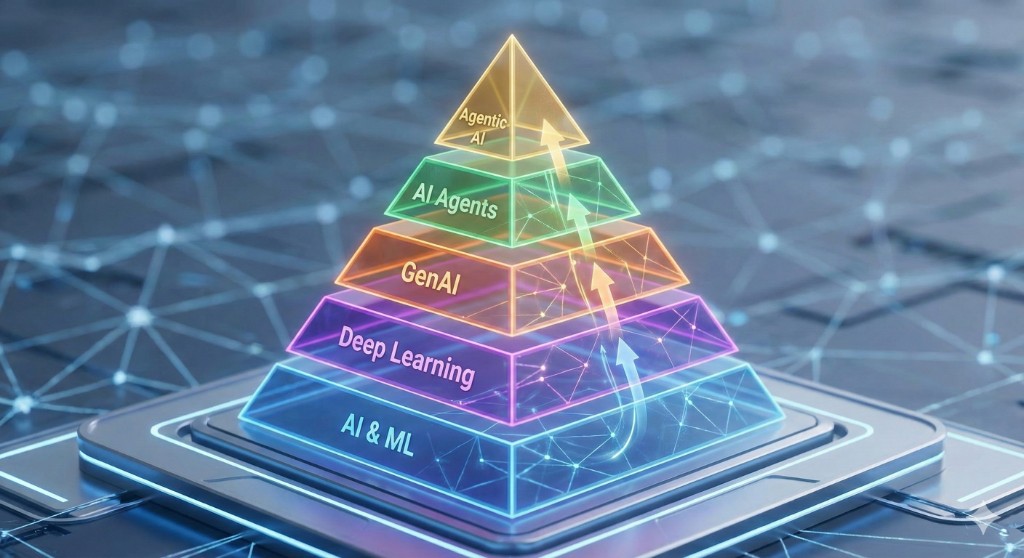
Use this 4-step framework to move from ChatGPT prompts to full-fledged AI agents. With concrete numbers and practical plan for SMBs.
Businesses that rely exclusively on ChatGPT prompts today are leaving an average of 5.6 hours per employee per week in recoverable manual work on the table. That doesn't sound dramatic — until you realize that a team of ten people is throwing away two full work weeks every month on tasks an AI agent could have handled long ago.
The good news: the jump from large language models (LLMs) to agentic AI is smaller than most managers think. This framework shows you how to make that jump — without a technical team, without months of preparation, without guessing.
What's the Difference Between an LLM and Agentic AI?
A Large Language Model (LLM) like ChatGPT or Claude is a text machine. You ask a question, the model gives an answer. Done. The model does nothing more until you type again. It has no memory between sessions, can't control external systems and doesn't make decisions without human input.
Agentic AI adds an execution layer. The agent uses an LLM for reasoning, but wraps it with:
- Memory (context across multiple sessions and tasks)
- Tools (access to your CRM, email, calendar, databases)
- Autonomy (the agent determines its own steps to achieve a goal)
- Loops (the agent checks its own results and corrects if needed)
Core difference: an LLM provides an answer. An AI agent provides a result.
The analogy works like this: an LLM is the advisor who explains how to process an invoice. An AI agent processes the invoice itself — including verification, accounting and status update to the customer.
Why LLMs Alone Aren't Enough for SMBs
Most SMBs started their AI journey with a chatbot or a helpful prompt. That makes sense — it's low-barrier and delivers quick results. But there comes a point where you hit the wall:
| Situation | What an LLM does | What You Actually Need |
|---|---|---|
| Invoice processing | Reads and summarizes | Automatically books in accounting |
| Answer customer question | Writes an answer | Sends the answer after CRM verification |
| Create quotes | Makes a template | Retrieves customer data and generates the quote |
| Schedule change | Suggests a message | Updates calendars and sends notifications |
Businesses that recognize this pattern are ready for the jump to agentic AI. Gartner predicts that 40% of all enterprise applications will contain AI agents by end of 2026 — versus less than 5% in 2025. Businesses that wait are falling structurally behind.
The 4-Step Framework: From LLM to Agentic AI
Step 1 — Process Audit (Week 1-2)
Don't start with technology. First map the processes that:
- Recur regularly (daily or weekly)
- Have predictable steps
- Are currently performed manually across multiple systems
Examples in SMBs: processing purchase orders, complaint triage, HR onboarding, lead qualification.
Tip: Ask your team "what do you do every week where you think: a robot should be doing this?" You'll have a list of ten suitable processes within an hour.
Step 2 — Data Foundation (Week 2-4)
Agentic AI only works if the data is in order. For each selected process, verify:
- Are the data stored somewhere structured (CRM, ERP, spreadsheet)?
- Are the systems reachable via an API or integration?
- Is there a clear definition of "successfully completed"?
You don't need to build a perfect data warehouse. One well-connected system is enough to start.
Step 3 — Pilot Project (Week 4-8)
Choose the one process with highest frequency and lowest risk. That becomes your pilot. Guidelines:
- Choose a process with maximum 5 steps
- Ensure an error is recoverable (no financial transactions in pilot phase)
- Measure the current duration per execution
Businesses that approach this correctly already see 40 to 60% time savings on the selected process in the pilot phase.
Step 4 — Scaling (Month 3-6)
After a successful pilot you have internal proof. Use that to:
- Strengthen management buy-in (numbers, not stories)
- Automate two or three related processes
- Appoint an internal AI team or AI manager
Warning: Don't scale too quickly. Long autonomous processes in production require error handling and human oversight — build those control layers in before you scale.
How Unify AI Executes This Framework
Unify AI guides SMBs through these exact four steps. We always start with a process audit and jointly select the top-scoring use case. Then we connect the existing systems via ready-made integrations — no custom work required.
Our AI agents are configured for common SMB processes: customer service, quotes, internal communication and reporting. You don't need a technical team to get started — our implementation partners guide you from A to Z.
Want to see which processes in your business will generate returns fastest? Check out our use cases by sector or book a free strategy session directly.
Concrete Results at SMBs
Businesses that fully execute this framework report:
- 5.6 hours per employee per week recovered on repetitive tasks
- 40-60% faster processing times on automated processes
- ROI on average within 4 months after first agent goes live
The investment in a first AI agent at SMB scale typically runs between €500 and €2,500 per month depending on the number of integrations and volume. At €50 per hour, a team of five has monthly value creation of €1,120 from each recovered work day.
Frequently Asked Questions
Do I need technical knowledge to start with agentic AI?
No. The 4-step framework is designed for operational decision-makers, not developers. You need a clear process overview and access to your systems — the implementation partner handles the technical side.
What does an AI agent cost for my SMB?
Most SMB implementations start between €500 and €2,500 per month, including integrations and support. Average payback period is under four months when the selected process has sufficient volume.
What if my data isn't in order?
That's the most common concern — and rarely a real problem. Agentic AI doesn't need perfect data, just structured data in a connectable system. Even a well-maintained Excel sheet or CRM is a sufficient starting point for the first pilot.
Does agentic AI work with existing tools like Outlook, Teams or my accounting software?
Yes. Via standard integrations, Unify AI connects with virtually all common SMB software packages. Check the complete integration overview for an up-to-date list.
Ready to Make the Jump?
Businesses that started with agentic AI in 2025 now have an operational advantage of at least 12 months over businesses that are still waiting. Competitors doing this already save two full work weeks per month per ten employees.
Schedule a free strategy session and discover which process in your business can be automated first — including a custom ROI calculation.