
From first conversation to go-live: how we build your agent
 Erwin Berkouwer
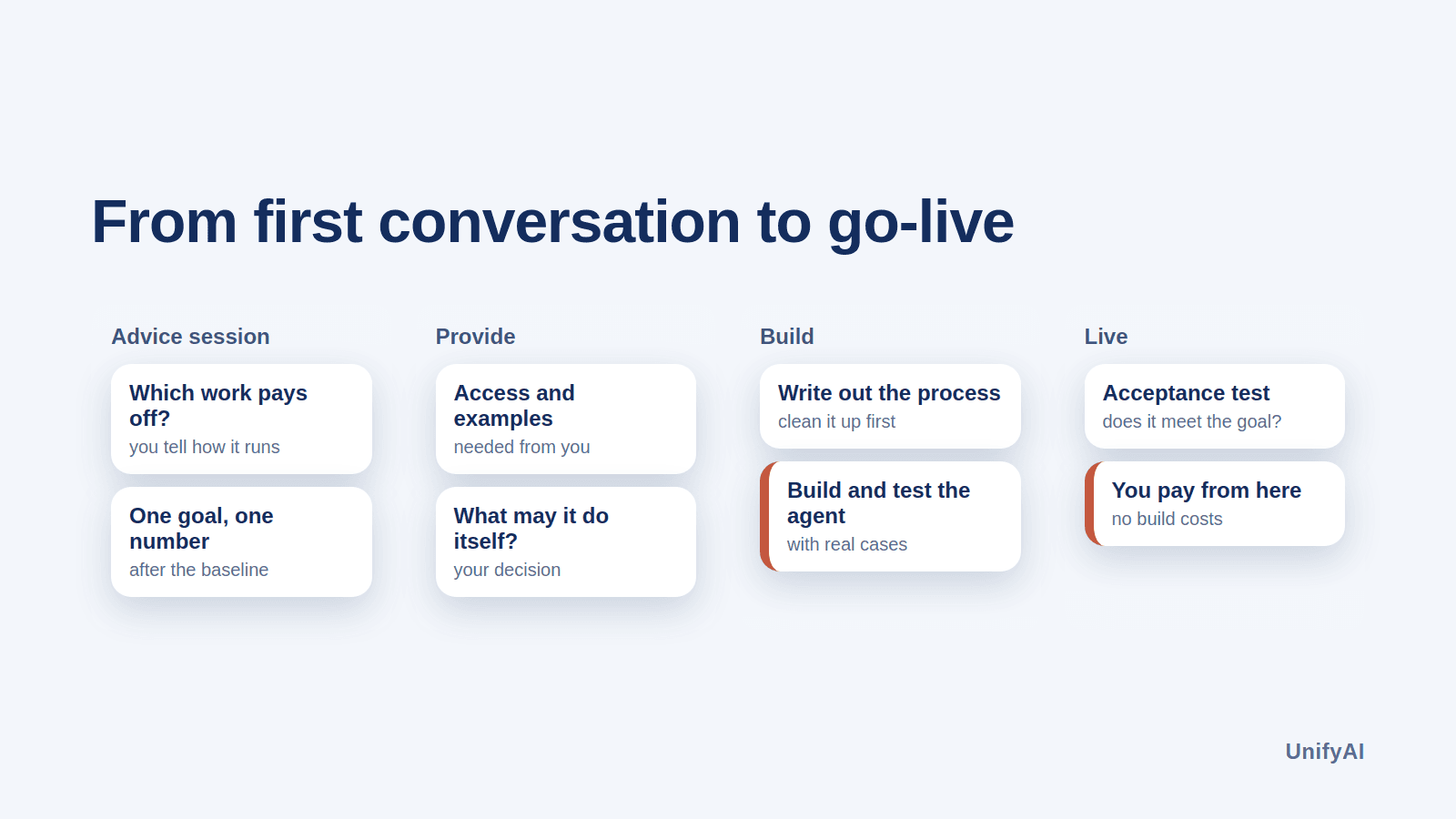
Having an agent built is not an IT project you hand off and see again a few months later. You know the work the agent takes over best. That is why you are at the table at every step, and your customer environment shows where things stand. Below you can read what happens at each step, what we do and what we need from you.
What happens in the advice session?
Together we go through the work that comes back every week: invoices someone retypes, emails answered the same way each time, quotes pulled together from three systems. You tell us how it runs now. We look at where an agent yields the most and where it does not.
The conversation leads to a proposal with a fixed price per month, the agent's goal and what we need from you. If an agent does not fit, we say so. Sometimes a better working agreement or a checklist is enough.
Why do we agree one goal up front?
An agent has to deliver something you can measure. Up front we choose one goal with a number together: time, speed, quality, money or availability. For that we first measure how the work goes now, the baseline. For example: so many invoices a month now take so many hours, and with the agent that has to become a fixed number of hours.
That goal is in your proposal. At the acceptance test we measure whether the agent meets it. Other benefits we report, but this one number is what you hold us to.
What do we build, and what do you do meanwhile?
We do not start building straight away. First we write out the process as it runs now, take out what is not needed and check the data the agent will work with. An agent on a messy process becomes a fast version of the same messy process.
Then we build the agent in the systems where the work happens now, such as your accounting package, your CRM or the shared mailbox. We test with real examples, including the hard ones. You look along: is what the agent prepares right, and what should it do when something deviates?
What do you need to provide?
After your approval, your customer environment shows a list under "Needed from you". What is on it depends on the agent, but this almost always comes back:
- One contact person who decides. Someone who may make the calls on setup and way of working. That saves more time than anything else.
- Access to the systems. A user of its own for the agent, with only the rights it needs, so we build and test with your real data.
- Examples of the work. A set of real cases: invoices, emails or requests, including the hard ones. That is where the agent learns the difference between normal and unusual.
- Decisions on what the agent may do itself. What does it prepare, what always goes past an employee and who approves?
- Someone who looks along and tests. The colleague who does the work now knows fastest whether an outcome is right.
How long does it take?
That depends on the work, the systems and how much the agent may do itself. What applies to your agent is in your proposal. One agreement is always the same: the lead time counts from when the decisions and data we need are in.
That is not small print. We cannot build on assumptions about a process or on test data that does not look like your real work. The sooner the list is done, the sooner your agent is live. Your customer environment shows which item is still open and with whom.
What happens at the acceptance test?
Before the go-live we measure whether the agent meets the agreed goal, with real cases and with an employee's review included. A colleague approves or adjusts every outcome. That way you see not only whether the agent can do the work, but also how much time approving takes.
If the agent meets the goal, you approve the go-live. From that day it is live and you pay. If it does not, we improve it first. What we agree if a goal is not met is in your proposal.
What happens after the go-live?
The agent starts by itself on every new case; nobody has to remember it. It prepares, an employee approves. The log shows what it did and how much time that saved. What it may later push through on its own, you agree together once you see it goes well.
Maintenance and hosting are included. When something changes in a system the agent works with, we adapt it.
Build it yourself or have it built?
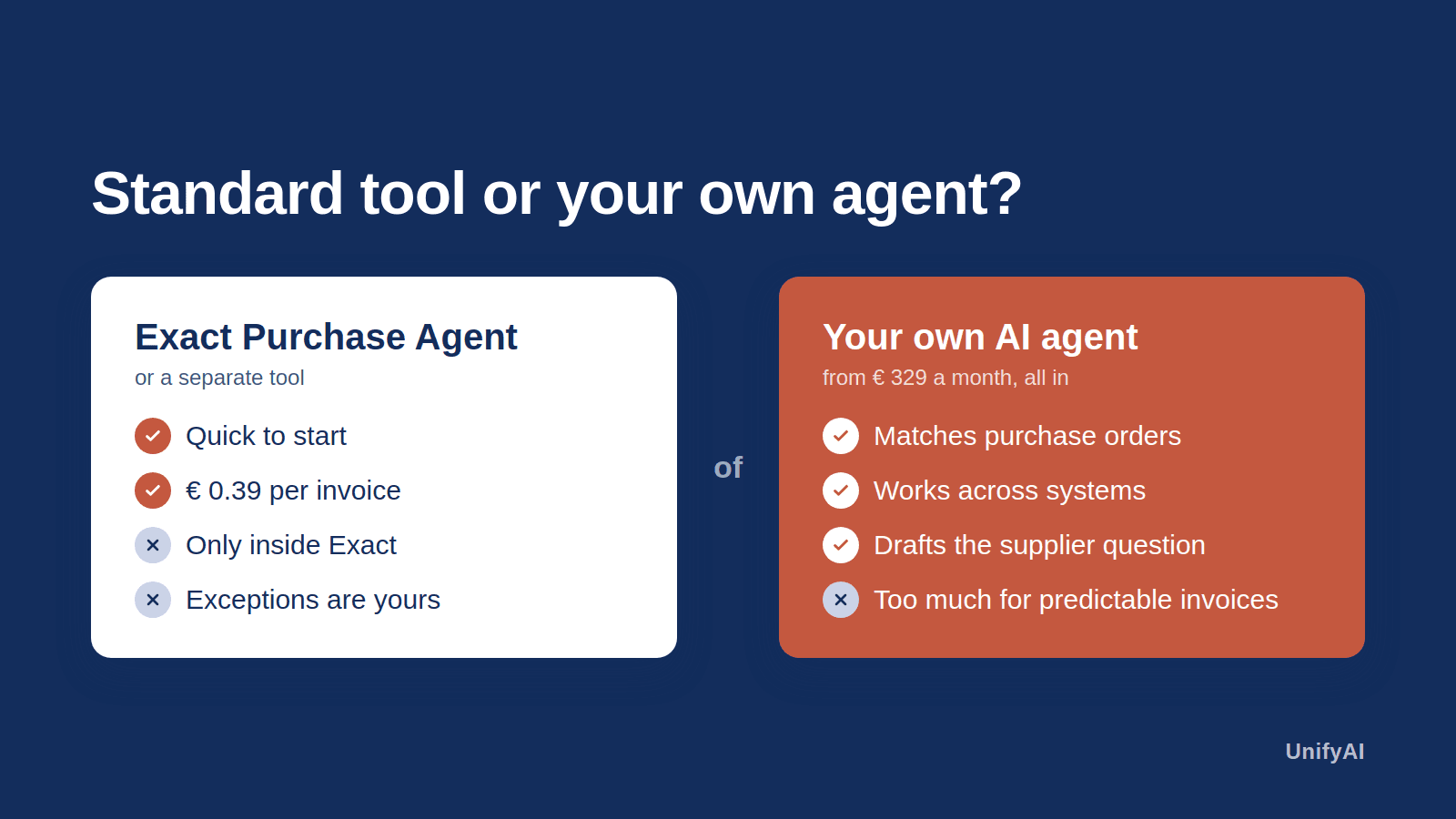
With an integration platform or a script of your own you can automate one simple task well yourself. Having it built pays off when the work has exceptions, runs across several systems or has to keep running reliably without your own team maintaining it. The pitfalls of building yourself usually come later: a connection that stops silently, an exception nobody foresaw or a colleague who leaves with all the knowledge.
What does it cost?
An agent costs a fixed amount per month at UnifyAI. The build, hosting, maintenance and use of the AI model are included. There are no build costs: you pay from the day the agent is live. What drives the price is in what does an AI agent cost.
Want to know which work yields the most for you? Plan an advice session.
Frequently asked questions
Short, clear answers so you can decide faster.
How do you start having an AI agent built?
With an advice session about the work that comes back every week. That leads to a proposal with a fixed price per month, one goal with a number and a list of what we need from you.
What do I need to provide for an AI agent?
A contact person who decides, access to the systems for a user of the agent's own, examples of the work including the hard cases, decisions on what the agent may do itself and someone who looks along and tests.
How long until an agent is live?
That is in your proposal per agent. The lead time counts from when the decisions and data we need are in.
When do I pay?
From the day the agent is live. There are no build costs; build, hosting, maintenance and the AI model are in the monthly price.
What if the agent does not meet the agreed goal?
We measure that at the acceptance test, before the go-live. If it does not meet it, we improve it first. What we agree if a goal is not met is in your proposal.
Does the agent do things without anyone seeing?
No. It prepares, an employee approves, and the log shows everything it did. What it may later push through on its own, you agree together.