Why 70% of AI implementations in SMBs fail (and how to avoid it)
 Erwin Berkouwer
Many AI implementations in SMBs don't deliver the result people counted on, and that's rarely down to the technology. Almost always it goes wrong because of four predictable mistakes: no clear problem, data that isn't in order, employees who aren't brought along and starting too big. Below you'll read what goes wrong and how to avoid it.
Caution is sensible, but waiting also costs something. If competitors automate their invoice processing, have AI answer customer questions and plan more smartly while you're still looking around, the gap grows. The good news: predictable mistakes can be avoided.
Why do so many AI implementations fail?
The figure of about 70 percent in this title is a rule of thumb: in a lot of research from analyst firms and consultancies, a large share of AI projects miss the intended return. The exact percentages differ per study and per definition of "failed". They do keep pointing the same way: the cause is more often the approach than the technology. Unclear business value and poor data quality in particular come up every time.
So AI does work. Four causes keep coming back.
Mistake 1: no clear problem defined
"We want to do something with AI" is not a strategy. Start without a specific, measurable goal (which problem are we solving, for whom, how do we measure success after 90 days?) and you end up with a proof of concept that never reaches production.
It costs you months of lead time and an investment in a project that stalls.
Tip: phrase your goal as a business problem, not a technology choice. "We want AI" is too vague. "We want to cut invoice processing from four hours to thirty minutes a week" is concrete.
The fix: start with one process that happens at least weekly, takes a lot of manual work and has a measurable outcome: time, cost or error rate. How to choose it is covered in AI strategy: start with a process.
Mistake 2: data not in order
AI runs on data. If your customer data sits in three systems, invoices are entered by hand and there's no single product catalogue, no AI tool will just fix that. Garbage in, garbage out. Behind projects that founder on "unclear business value" there's often a data problem: too little data, unclean data or data that can't be reached.
| Data situation | What it means | Action |
|---|---|---|
| Data in one system, structured | Ready for AI | Start right away |
| Data in several systems, inconsistent | Preparation needed | Clean up the data first |
| Data on paper or by hand, barely digitised | Fundamental step needed | Digitise first |
| Little or no historical data | AI has too little input | Start small or find extra data sources |
The fix: do a data quality check before you compare tools. Data in order helps with this, and through integrations you bring scattered data together without a big IT project.
Mistake 3: employees aren't brought along
Lack of expertise is often named as the biggest barrier to AI in SMBs. But you don't buy expertise in one go: you build it. If employees don't understand why AI is being used and how to work with it, they don't use it or they use it wrongly. Companies that also invest in behaviour and ways of working have a better chance than companies that only look at technology. That's what AI adoption is about.
Tip: appoint an internal AI owner for every implementation: an employee who works with the system every day, is responsible for the results and guides colleagues. No owner often means no adoption.
The fix: involve the people who'll use the system before you choose tools. Their resistance or enthusiasm says more about your chance of success than a supplier's demo.
Mistake 4: starting too big
Tackling a complete AI transformation in one go is almost always a recipe for failure. A big system for, say, stock optimisation, with no owner and too little focus, is often still not live months after the start.
The opposite works better: start with one employee, one region or one department and a small amount of historical data. A small pilot quickly gives you a working result that you can then scale up. You'll find more on this in how to make an AI pilot succeed in SMBs.
Tip: use a 90-day rule. If a pilot hasn't produced measurable results within 90 days, the goal is too vague or the scope too big. Stop in time, before you invest more.
What's the difference between failing and successful AI projects?
| Factor | Failing project | Successful project |
|---|---|---|
| Goal | "We want to do something with AI" | Specific business problem defined |
| Scope | Whole organisation at once | One process, one department |
| Data | Scattered, manual, unstructured | Central, structured, accessible |
| Ownership | IT project without a business owner | Business owner, IT as the one who builds |
| Employees | Told after the implementation | Involved in the choice and design |
| Measuring success | Vague KPIs | Concrete checkpoint after 30, 60 and 90 days |
| Budget | Big system in one go | Targeted pilot with a limited budget |
What does a successful approach look like?
Companies that do roll out AI successfully follow a recognisable pattern:
- One specific pain point as the starting point, not the whole organisation.
- A data inventory before tool selection: know what you have.
- An AI agent or workflow that supports the process, not replaces it.
- A pilot of a few weeks with one measurable result.
- Scale up after proof, not after assumption.
You can read how UnifyAI handles this under AI implementation and on the page about our way of working.
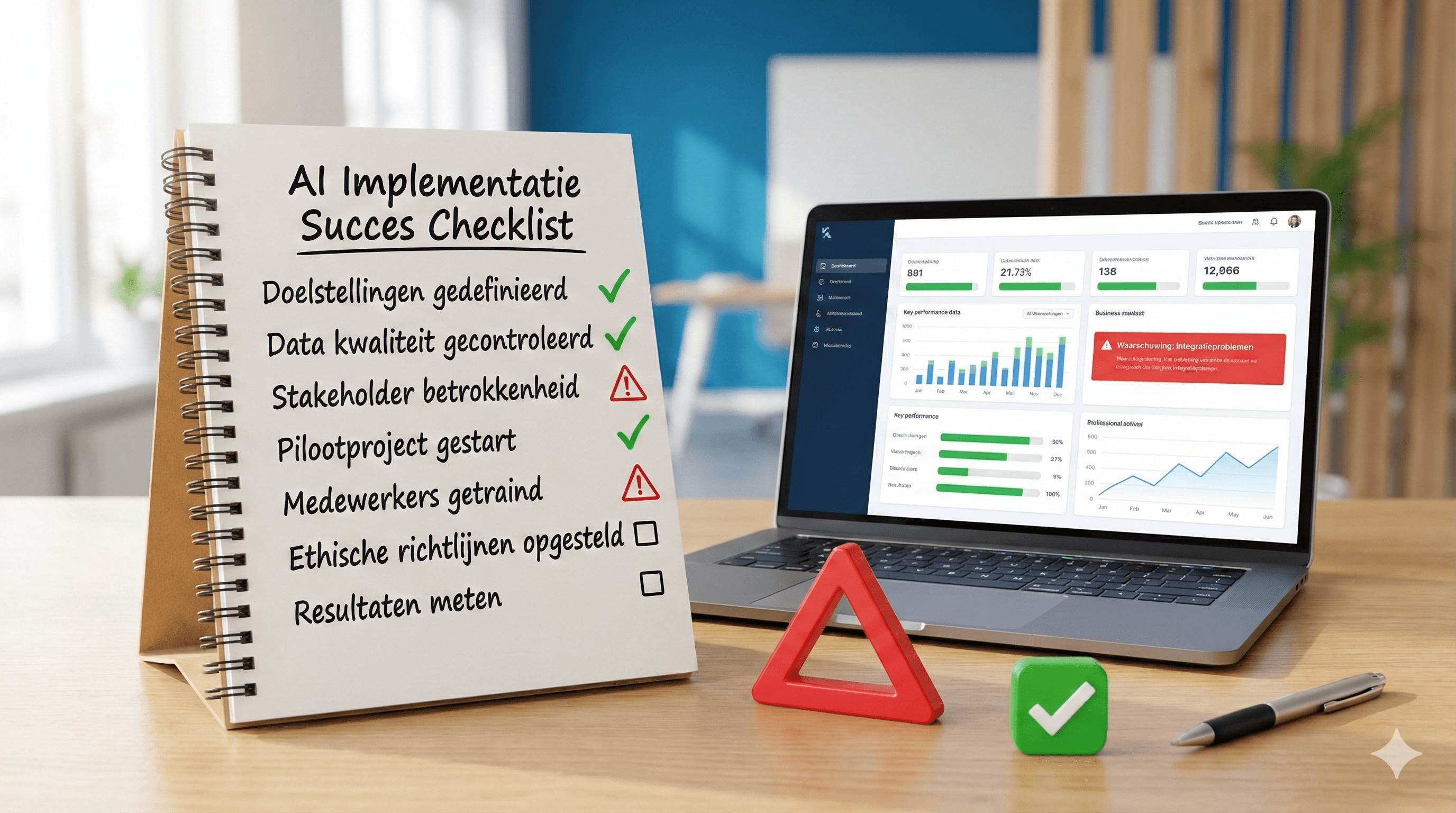
Which checklist do you run through before you start?
Answer honestly before you invest:
- Which specific problem are we solving?
- Do we have enough clean, accessible data?
- Is there an internal owner who's responsible for the results?
- Are the employees who'll work with it involved in the choice?
- What's the measurable result after 90 days?
- Does the scope fit in a pilot with a limited budget set in advance?
If you can't answer three or more questions, it's too early to invest. Want to know where your business stands? An AI scan helps you map that.
What's a good next step?
Want to know if your business is ready for AI and which step makes sense first? Make an AI scan or book an intro call.
Frequently asked questions
Short, clear answers so you can decide faster.
Why do so many AI projects fail in SMBs?
Most failures come down to four causes: no clear goal, disorganised data, employees not brought along and starting too big. Technology is rarely the problem.
How long does a successful AI implementation take in an SMB?
A first working pilot can often be done in a few weeks. How long full adoption within a department takes depends on the process, the data and how well employees are brought along.
How much should I invest in AI for my business?
That depends on the process and the connections you want. Start with a targeted pilot for one process with a budget set in advance, and only scale up once the result is measurable.
Does my business need technical knowledge to implement AI?
Not necessarily. Many AI tools are ready to use out of the box. For custom work you do need a partner who understands the technology and knows your business process.
What if my AI project isn't going well right now?
Stop, evaluate and restart with a narrower scope. A failed pilot gives you information you can use to make a better second attempt, with clearer goals and more focus.