How to Make an AI Pilot Succeed in an SME
 Erwin Berkouwer
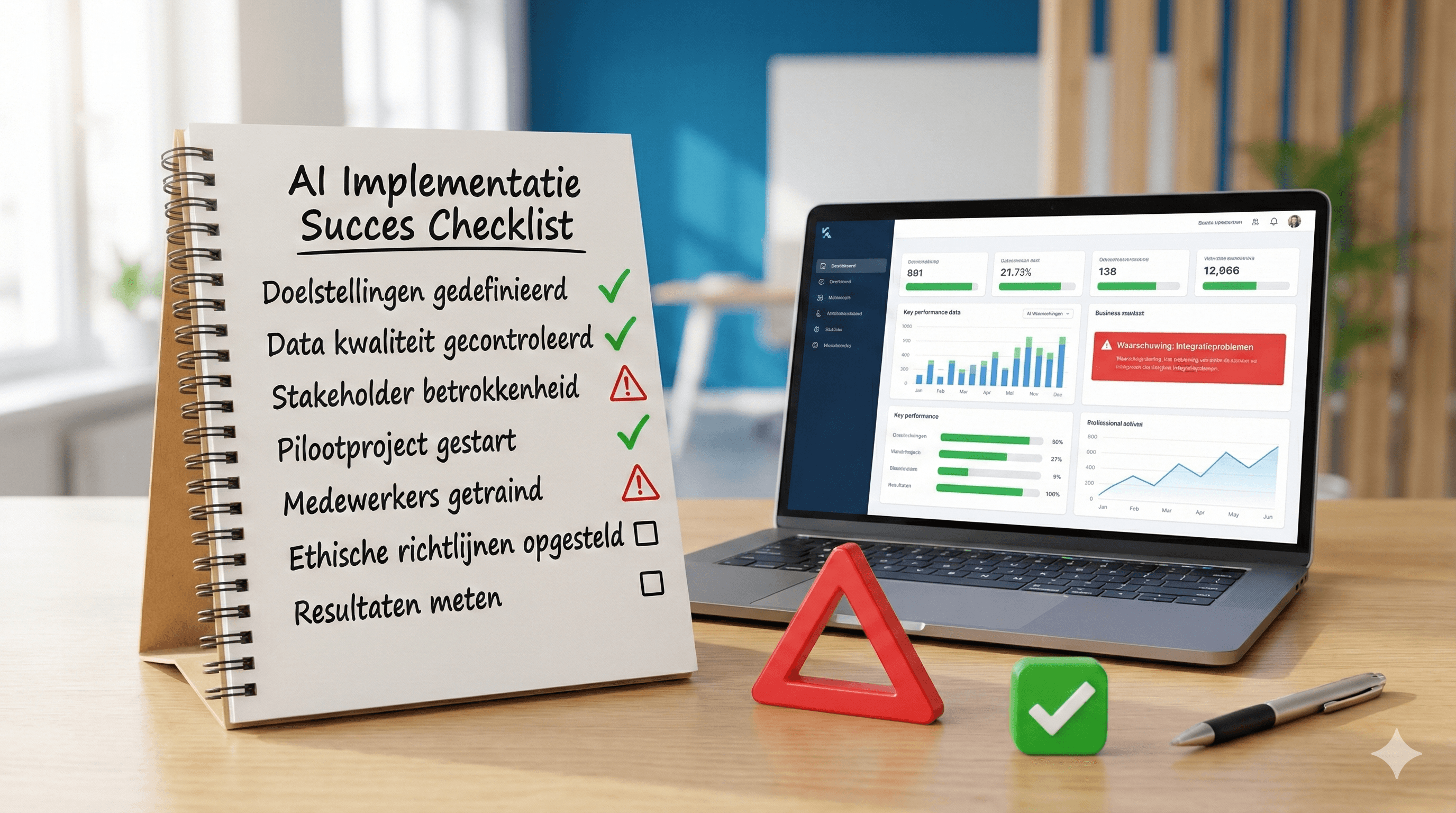
An AI pilot succeeds if you define success upfront, work with clean data, appoint one owner and bring the team along. The pilot itself is rarely the problem: most pilots stall because nothing was prepared for scaling up. Below you'll read what a pilot needs, which steps take you from pilot to structural use and when you're better off waiting.
Why do so many AI pilots stall after the test phase?
Starting an AI pilot is easy these days. Building a chatbot, testing document classification or trying a bit of process automation takes little time and often little money. The problem isn't starting, it's growing.
Many SMEs recognise this pattern: the pilot works fine technically, everyone is enthusiastic during the demo, and then nothing happens. No scale-up, no structural use, no follow-up. The pilot ends up in test-phase limbo: too good to throw away, too small to take seriously.
That's rarely because AI doesn't work. The conditions for scaling up are often only thought about once the pilot is already running. If you lay the right base upfront, you stop the pilot from staying a one-off experiment.
What does an AI pilot need to succeed?
A successful pilot isn't necessarily the one with the most impressive technology. It's the one that meets a number of conditions before the first line of code is written.
1. Clear scope
A pilot with a vague brief (“see what AI can do for us”) rarely delivers anything usable. A sharply defined question (“can we have 80 percent of our incoming invoices categorised automatically”) does. The smaller and more specific the scope, the easier it is to tell whether the pilot succeeded.
2. Data quality
AI depends heavily on the quality of the underlying data. Incomplete, outdated or inconsistent data produces a pilot that fails on paper while the real problem lies in the data. A short data check upfront saves a lot of disappointment. If your data is a bottleneck, Data in order is a logical first step.
3. Ownership
A pilot without an owner has no driver at the moment things get tense: when there's a setback, when budget is needed for scaling up or when colleagues have to get used to a new way of working. Ownership means one person who is responsible for the result, with the authority to make decisions.
4. Measurable KPIs
Without measuring points set in advance, every pilot is “interesting” afterwards, but rarely convincing enough to get budget for scaling up. Think of time saved per week, error rate, lead time or customer satisfaction. Measure this before you start, so you have a baseline.
5. Change management
The best technical solution fails if the people who have to work with it weren't brought along. Change takes time, explanation and sometimes repetition. If a pilot skips this, the team easily falls back on the old way of working afterwards. That's what AI adoption is about.
How do you go from pilot to scale-up?
The plan below is meant to be practical, not a theoretical model. It's an order that often works in SMEs.
- Choose the right use case. Start with a concrete, recurring problem with measurable impact, not the most impressive AI application. Think of a process that takes a lot of time, causes a lot of errors or needs a lot of customer contact.
- Set scope and success criteria upfront. Put in numbers what “successful” means. That avoids arguments afterwards.
- Test small and iteratively. Work with a limited dataset or a small team. Learn fast, adjust and repeat. A pilot of four to eight weeks often gives a good picture already.
- Evaluate on data, not on feeling. Compare the results with the baseline. Was the time saving real, or did it just seem so?
- Make a scale-up plan before you scale up. What capacity, budget and training do you need to roll this out more widely? Who is responsible for what comes next?
- Scale up in phases. Add users, processes or departments step by step instead of launching across the whole organisation at once.
Want a hand choosing the right use case? An AI scan gives you a first picture of where AI pays off most in your business.
What does a successful pilot look like in practice?
The examples below are illustrative and not real client cases. They show how pilots with a small scope and a recognisable problem go.
Categorising invoices. An accountancy firm tests AI for four weeks to categorise incoming invoices, on part of the invoices of three clients. Success criterion upfront: at least 70 percent correct without manual correction. That turns out to be achievable for invoices with a fixed format, but not for poor-quality scans. That's exactly the outcome you want: you know where you can and can't rely on it when you scale up.
Frequently asked questions in chat. A customer service team tests an AI assistant for six weeks that answers frequently asked questions, alongside human staff and with one team of four people. They measure response time, satisfaction and the percentage of questions solved without escalation. Because the staff know upfront what the assistant can and can't do, there's little resistance and the pilot can grow to the rest of the team.
Predicting maintenance. A manufacturer tests AI for predicting maintenance moments based on sensor data. The pilot gets stuck, not because of the technology, but because two years of sensor data turn out to be incomplete and inconsistent. The company first gets its data quality in order and then starts a new pilot. That's a useful outcome too: no time and money went into scaling up something that wasn't ready yet.
So a pilot doesn't have to end in scaling up straight away. A pilot that makes clear what works and what doesn't, and why, has succeeded too.
What does an AI pilot cost, and what does scaling up cost?
Costs vary a lot by use case, sector and complexity. The figures below are an indication based on typical SME projects, not a quote.
| Phase | Typical investment | Lead time |
|---|---|---|
| Small pilot (1 process, limited team) | roughly €3,000 to €10,000 | 4 to 8 weeks |
| Larger pilot (several departments, integrations) | roughly €10,000 to €30,000 | 8 to 12 weeks |
| Scaling up across the whole organisation | roughly €25,000 to €100,000+, depending on integrations and number of users | 3 to 12 months |
The final cost depends on existing systems, available data and the amount of custom work. A well-run small pilot often gives you exactly the information to estimate scale-up costs more realistically.
When doesn't an AI pilot pay off yet?
Not every moment is the right moment. These signals mean you're better off waiting or solving something else first:
- No internal sponsor. Nobody feels responsible for the result.
- Poor or missing data. Without usable data, most AI delivers little, however good the model is.
- The wrong use case. Chosen because it's impressive, not because it solves a real problem.
- Wanting too much too fast. Rolling out across the organisation straight away without testing, learning and adjusting first.
- No room for change. The team has no time or willingness to learn new ways of working.
Do you recognise one of these signals? Then get the conditions in order first and only then start the pilot. A conversation with an AI adviser can tell you whether the timing and use case are right before you commit resources.
What does UnifyAI do in an AI pilot?
UnifyAI works with SMEs to choose the right use case, set up a pilot with clear KPIs and scale up once the pilot has proven its value. That can be with AI agents that take over repetitive tasks, or with broader AI consultancy for the longer term.
Want to talk through the scope, use case or approach of your own pilot? Book an intro call.
Frequently asked questions
Short, clear answers so you can decide faster.
How long should an AI pilot last?
Most pilots in SMEs last between four and twelve weeks. Shorter often gives too little data for reliable conclusions, longer raises the risk that the pilot loses momentum.
What's the biggest reason AI pilots fail?
Often not the technology, but the lack of clear ownership, measurable KPIs upfront or attention for the people who have to work with it. Technology that works but isn't used isn't a successful pilot.
Should I pick a big AI solution straight away?
No. Start small, with a concrete and defined problem. A small pilot with a measurable result is a stronger base for scaling up than a big project that gets bogged down in complexity.
Roughly what does an AI pilot cost for an SME?
That varies a lot, but a small pilot is usually between €3,000 and €10,000. Larger projects with several departments or integrations can come out higher. Always ask for a proposal based on your own situation.
How do I know whether a pilot succeeded?
If you set measurable success criteria upfront, such as time saved, fewer errors or lead time, you can judge it objectively afterwards. Without those criteria, it stays guesswork.