AFAS vs Exact Online: which fits your SME? (2026)
 Erwin Berkouwer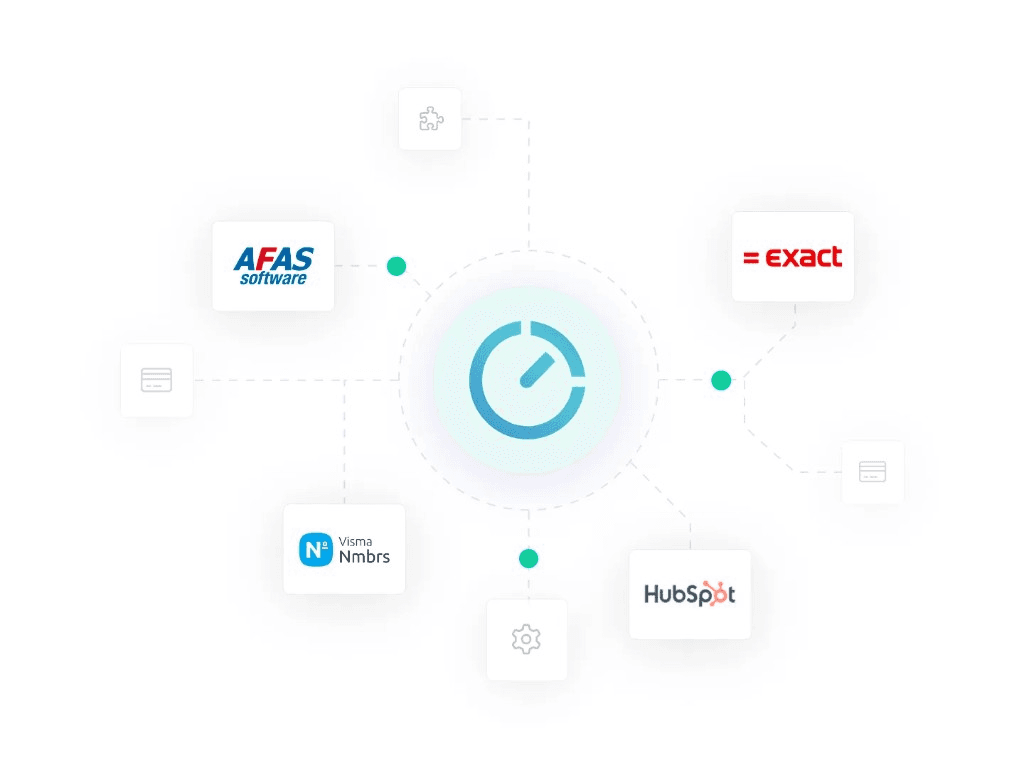
AFAS usually suits a company with a lot of staff that wants HR, payroll and finance in one system. Exact Online suits you better if accounting is your centre of gravity, you work closely with your accountant and you want to start small. Both are Dutch and both are used by many SMEs, but they are not two flavours of the same thing.
AFAS is a broad, integrated business package where finance, HR, payroll and workflows come together. Exact Online is at heart an accounting package that you extend with modules, and it is deeply rooted in the accountancy world. So 'which one is better?' is the wrong question. What matters is how your company is put together: lots of staff, or mainly books that have to be right? Do you work closely with an accountant? Do you want everything in one system, or separate building blocks? Below I put the two side by side honestly, including where each one falls short.
Where do AFAS and Exact Online come from?
To understand the two packages, it helps to know what they were originally built for.
AFAS started as a supplier of integrated business software for mid-sized organisations. The philosophy: one system, one database, where all business processes come together. Financial administration, HR, payroll, invoicing, CRM and workflow share the same data instead of sitting next to each other as separate islands. Hire an employee and that hire shows up automatically in payroll and in the cost booking. That makes AFAS strong where HR and administration go hand in hand.
Exact Online comes from a different corner: accounting. It has grown into one of the best-known financial packages for Dutch SMEs and accountancy firms. The core is your general ledger, your receivables and payables and your VAT return. Around that you add modules: invoicing, CRM, projects, stock, hours, and also HR and payroll. So you build the size that suits you, with accounting as the foundation.
What can AFAS do, and where does it fall short?
Where AFAS excels:
- HR and payroll in one flow. Personnel files, leave, expense claims, contracts and payroll sit in the same system as your finance. With a lot of staff, that saves double work and retyping.
- Processes and workflow. AFAS captures processes: a leave request that goes to the right person, an invoice that automatically goes for approval. Everything runs through one engine.
- Self-service portals. Employees and sometimes customers handle things themselves, such as viewing payslips, changing details or submitting requests, while all modules share the same data source.
Where AFAS falls short:
- It's a lot, sometimes too much. For a freelancer or a small company without staff, a large part of the functionality is dead weight: you pay for and manage a system built for more complex organisations.
- Implementation is a project. Setting up AFAS is rarely an afternoon job. You usually set up processes, authorisations and integrations with a consultant or partner, and that takes lead time before you go live.
- Your accountant probably doesn't work in it. Many accountancy firms run on other packages. If you use AFAS, you more often do your financial administration in-house.
What can Exact Online do, and where does it fall short?
Where Exact Online excels:
- Accounting as home base. The package is built around your financial administration and does that thoroughly: general ledger, VAT, receivables and payables, bank connections.
- Working with your accountant. Perhaps the biggest advantage. Many accountancy firms work in Exact Online themselves. Your bookkeeper then has direct access to the same administration, with no files going back and forth.
- Building it up in modules. You start with accounting and switch on what you need: invoicing, CRM, projects, stock. You can start small and grow along.
- A large integration ecosystem. Exact has a public REST API and a large collection of third-party apps. From webshop to time tracking: chances are a ready-made integration already exists.
Where Exact Online falls short:
- HR and payroll aren't the core. There are modules for personnel and payroll, but the package is not primarily an HR system. With a lot of staff and complex HR processes, you hit limits sooner than with an integrated ERP.
- Modules pile up. Every module you switch on is an extra building block and an extra cost. With broad needs, the whole feels less like one system than an all-in package does.
- Workflow is more limited. Exact is stronger at recording than at steering broad business processes across departments. If you want heavy, continuous workflows, you'll notice the difference.
How do they compare on the points that matter to SMEs?
Functionality and scope. AFAS covers a broad set of business processes in one system: finance, HR, payroll and workflow. Exact Online starts with finance and expands with modules. If you want one system for everything, that leans towards AFAS. If you mainly want strong accounting with the freedom to add on, lean towards Exact.
Ease of use and learning curve. Exact Online is relatively quick to pick up for an accounting task. AFAS has a steeper learning curve because of its breadth, but in return processes run in one environment.
Integrations and API. Here there is a clear difference. Exact has a public REST API and a large ecosystem of third-party apps. AFAS offers official integration options through its own API, but in a more closed setup with fewer third-party integrations. If you want to plug in a lot of external software, Exact is generally more flexible.
Reporting and scalability. AFAS draws from one shared data source, which keeps figures consistent across departments, and it grows with a growing workforce and more processes. Exact delivers strong financial reporting, but an overall view across many separate modules takes more set-up. With very complex operations, a full ERP comes into view sooner.
Pricing model (the model, not amounts). AFAS works with an all-in subscription where functionality is bundled, which is predictable. Exact Online charges per module: you pay for the modules you switch on, with an entry level that is also accessible to freelancers and small SMEs. Always ask for a current quote.
AFAS vs Exact Online at a glance
| Aspect | AFAS | Exact Online |
|---|---|---|
| Origin | Integrated ERP/HR | Accounting with modules |
| Strongest point | HR, payroll, workflow, one system | Financial administration, working with your accountant |
| Accountant works in it | Usually not | Often, in the same environment |
| Integrations | Official API, more closed ecosystem | Public REST API, large app ecosystem |
| Pricing model | All-in subscription | Modular, per module switched on |
| Implementation | Project-based, often with a partner | Quicker to start |
| Best fit | Mid-sized, lots of staff | Freelancer to SME, accounting at the centre |
Which package fits your situation?
Neither is objectively better. It comes down to where your company's centre of gravity lies.
Lean towards AFAS if:
- You have a lot of staff and HR and payroll are a serious part of your administration.
- Your business processes run across several departments that you want to steer from one system.
- You deliberately want to get rid of separate tools that don't talk to each other and you're willing to invest in a thorough set-up.
- Predictable, bundled costs suit you better than adding up separate modules.
Lean towards Exact Online if:
- Your centre of gravity is financial administration and HR is limited.
- You work closely with an accountant, especially one who already works in Exact.
- You want to start small and only switch on modules when you need them.
- You want to connect a lot of external software (webshop, till, time tracking).
Who is AFAS overkill for? The freelancer and the small company with little or no staff. You'd be paying for and managing functionality you don't use. An accounting package with an entry module takes you further.
When does Exact become too limited? When you grow into an organisation where HR, payroll and broad work processes become as important as accounting. Then adding modules starts to chafe and an integrated package comes into view.
What role does your accountant play?
Don't underestimate your accountant's say. For many SMEs the administration is a shared responsibility: you supply, your accountant checks and reports. If your accountant already works in Exact Online, that's a weighty argument. Working together then happens without exporting and importing, with the same figures for both of you. If you're considering AFAS, ask up front whether and how your accountant can work with it. A package that fits technically but clashes with your accountant ends up costing you more time. You can read more about what an AI agent does with invoices and administration on the invoices and administration page.
Can you switch from AFAS to Exact Online or the other way round?
Switching packages is not a knob you just turn. A few things to weigh up front:
- Pick a sensible switch moment. The year-end is usually the calmest point: you start a new financial year clean in the new system. Mid-year is possible, but it makes reconciling the figures more complicated.
- Payroll is sensitive. Migrating payroll mid-year takes extra care because of cumulative figures and annual statements. The year-end is often the wisest choice here too.
- Think about your history. Open items, ledger balances and historical data have to come along or stay accessible. Decide up front what you move and what you keep in the old system.
- You'll rebuild your integrations. Links with the webshop, till or other software are specific to the package. Expect to set them up again.
- People need time to get used to it. The biggest cost is rarely the software itself, but the time your team needs to get used to the new system. Plan in some coaching.
So a switch is rarely purely a software choice. It's a change project. Do it deliberately and at a quiet moment.
What does an AI agent do on top of AFAS or Exact Online?
Whichever package you choose, it remains a system that holds data and supports processes. It doesn't act on its own. That's where an AI agent comes in: software that independently carries out a defined task based on the data in your package, with your approval at the important moments.
Concretely, such an agent can add things like this:
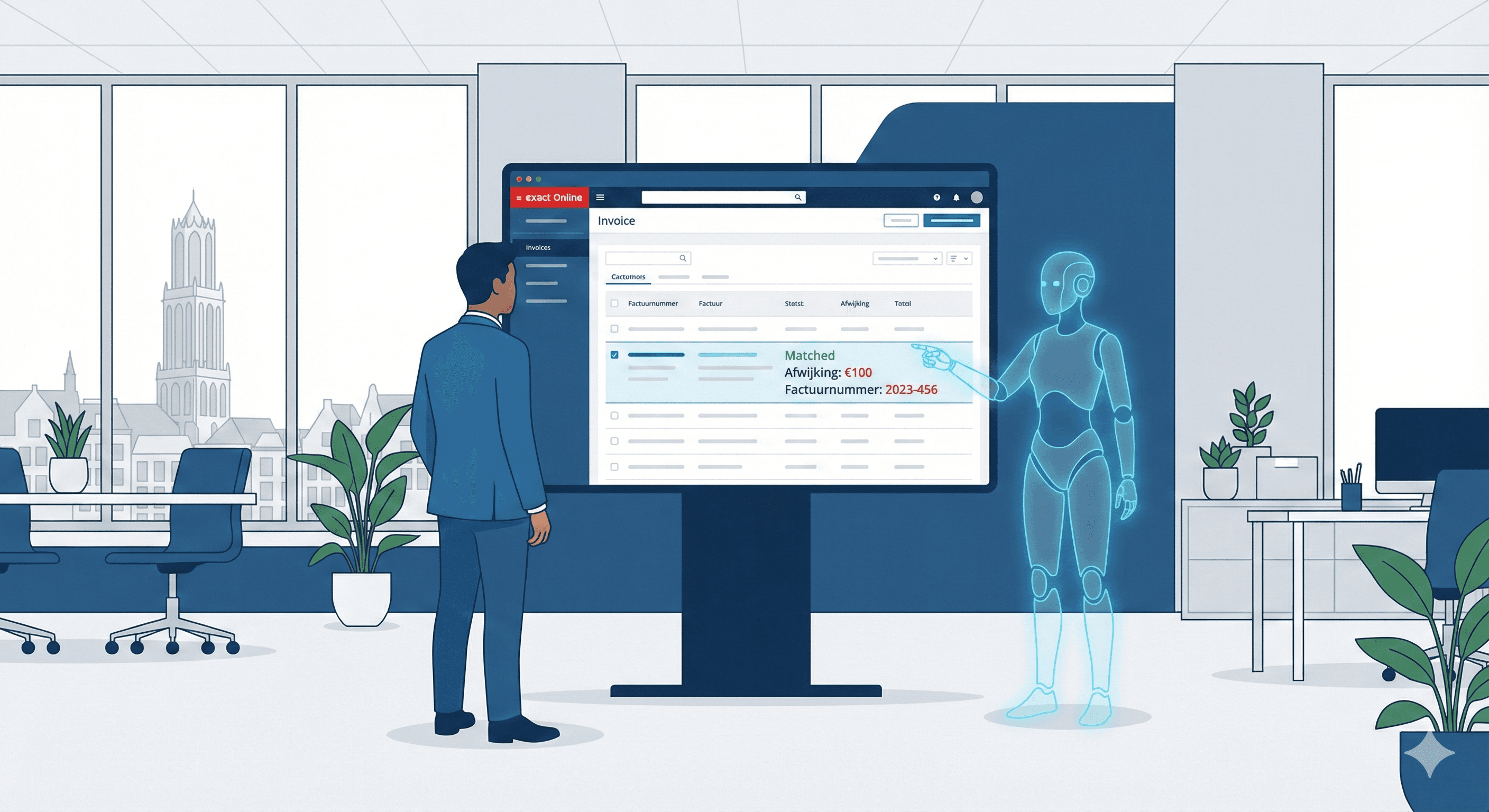
- Process incoming documents. Invoices, receipts and contracts that arrive by email are read and entered into your package as booked or prepared lines, instead of being retyped by hand.
- Answer questions with your own data. An employee or customer asks something ('what's still open for this debtor?', 'how much leave do I have left?') and the agent pulls the answer from AFAS or Exact.
- Flag issues. The agent keeps an eye on open items that stay open too long, budgets that are about to be exceeded or deviations in the figures, and raises the alarm in time.
UnifyAI connects to both packages through their official APIs, see the integrations. The agents run on EU hosting, with a data processing agreement and a person in the loop for decisions that matter. For Exact-specific uses there is a separate practical guide on connecting Exact Online to AI. Want to know which processes at your company are suited to automation? Run an AI scan.
In short
AFAS and Exact Online both solve the SME administration problem, but from a different angle. AFAS is the choice if you want one integrated system where finance, HR and payroll come together: strong with more staff, heavier to set up. Exact Online is the choice if you put accounting at the centre, work closely with an accountant and want to grow in modules: easier to start with, but less of an all-in-one. Let the centre of gravity of your company guide the choice, involve your accountant, and remember that you can put AI automation on either package once the basics are in place.
Sources
- AFAS Help Center, AFAS Software
- Exact Online developer documentation, Exact
Frequently asked questions
Short, clear answers so you can decide faster.
What is the difference between AFAS and Exact Online?
AFAS is a broad, integrated business package where finance, HR, payroll and workflows come together in one system and one database. Exact Online is at heart an accounting package that you extend with separate modules and that many accountants use themselves. AFAS is stronger with a lot of staff and workflow, Exact with accounting and working with your accountant.
Which is better for a freelancer or small SME?
For a freelancer or a small company without much staff, Exact Online is usually the more logical choice, with an entry module for the accounting. AFAS is then often overkill: you pay for and manage functionality you don't use. As you get more staff and broader processes, an integrated package like AFAS becomes more interesting.
Can I switch from Exact Online to AFAS (or the other way round)?
Yes, but it is a change project, not a simple switch. Preferably choose the year-end as the moment, pay extra attention to payroll because of cumulative figures, decide which historical data has to come along and expect to set up your integrations again.
What role does my accountant play in the choice?
An important one. If your accountant already works in Exact Online, that's a weighty argument, because you then work in the same administration without exchanging files. If you're considering AFAS, ask up front whether and how your accountant can work with it.
Does AI work with both AFAS and Exact Online?
Yes. Both packages have official APIs, so an AI agent can read data and write it back. UnifyAI connects to both through those APIs, on EU hosting and with a person in the loop for important decisions.