Is Your Business AI-Ready? SMB Checklist
 Erwin Berkouwer
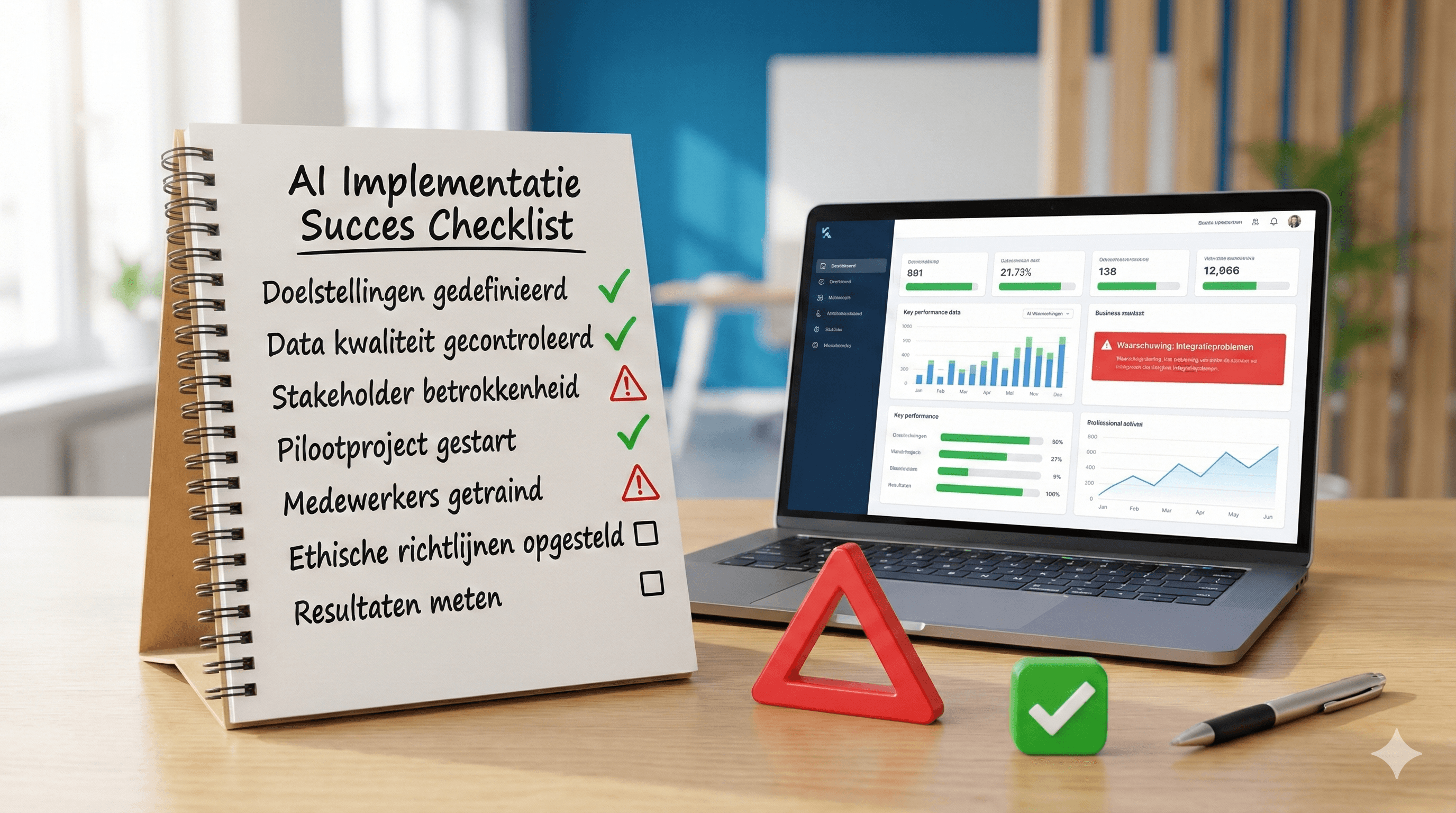
With this 6-point checklist, you'll know in ten minutes if your SMB is ready for AI. Per criterion, three concrete scenarios: ready, almost ready, or not yet ready.
Companies delaying AI implementation lose an average of 4–8 hours per employee weekly to tasks that could already be automated. Every month you wait, the gap with competitors who've already started widens. With this 6-point checklist, you'll know where you stand in ten minutes—and what the logical first step is.
The checklist has six criteria. For each, you'll find three scenarios: ready, almost ready, or not yet ready. At the end, you'll see which readiness level fits you and what to do next.
Remember: "Not yet ready" isn't failure. It's an honest starting point that helps you do the right things first, so an AI project will actually succeed.
Overview: 6 Criteria at a Glance
| # | Criterion | Ready | Almost Ready | Not Yet Ready |
|---|---|---|---|---|
| 1 | Repeating tasks | 4+ hours/week, set pattern | Tasks exist but vary | Every case is different |
| 2 | Usable data | CRM/ERP actively maintained | Partly in systems, partly Excel | Scattered or barely digital |
| 3 | Team buy-in | Champion + management support | Interest but skepticism | Active resistance |
| 4 | Measurable goal | Specific problem + KPI | Direction but no measurement | Don't know where to start |
| 5 | Budget | Pilot budget reserved | Available in principle | Not on agenda |
| 6 | Internal owner | Owner assigned + time | Everyone agrees, no one responsible | Top-down without buy-in |
Criterion 1: Do You Have Repeating, Time-Consuming Tasks?
AI delivers the most value for tasks that recur regularly, follow predictable steps, and take substantial time. Examples: invoice processing, categorizing customer emails, assembling quotes, qualifying leads, or running reports.
Ready: You have at least one task taking 4+ hours per week per employee that always follows the same steps. Employees find it repetitive.
Almost ready: The tasks exist but vary. Sometimes there are exceptions or unclear process steps. Write a quick process description and you're there.
Not yet ready: Every case is different. Nearly all tasks require custom work and human judgment. AI can help here, but full automation is premature.
Rule of thumb: A repeating task costing 4+ hours weekly is almost always worth automating. Typical payback: 3–12 months.
Criterion 2: Do You Have Usable Data Available?
AI works with data. You don't need big data, but it needs to be available, reasonably structured, and accessible. Data scattered across dozens of Excel files without consistent structure is a prep point, not a blocker.
Ready: You have a CRM, accounting system, or ERP (like Exact Online, AFAS, HubSpot, or similar) that's regularly maintained. Data is digital and mostly consistent.
Almost ready: Data mostly lives in systems but partly in loose Excel files or emails. Two to four weeks of cleanup puts the foundation in place.
Not yet ready: Data sits in personal folders, paper forms, or is barely digital. You need a data strategy first before AI makes sense.
Criterion 3: Does Your Team Have Buy-In?
Technology succeeds or fails primarily on adoption. An AI agent nobody uses delivers nothing. You don't need everyone excited, but the people who do the process daily need to be open to change.
Ready: At least one person on the team actively wants to use AI and knows the process. Management supports the initiative.
Almost ready: There's interest but also skepticism. That's normal. A small pilot with visible results typically addresses this. Communicate what changes and what doesn't.
Not yet ready: There's active resistance or fear of job loss, and management hasn't had that conversation. First address that; otherwise any initiative will stall.
Criterion 4: Do You Have a Concrete, Measurable Goal?
"Do something with AI" isn't a goal. A real goal is: reduce time to process quotes from 45 to 10 minutes daily, or handle 30% more customer emails per day per person. Without a measurable goal, you can't tell if a project succeeded.
Ready: You can describe in one sentence which problem you're solving, which KPI improves, and how you'll measure it. You know which process costs the most time.
Almost ready: You have direction but no concrete measurement yet. This week, track how long a specific task takes and write it down.
Not yet ready: You want to apply AI but aren't sure exactly where. Start with an internal process analysis or request a free AI scan to identify the most promising processes for your situation.
Criterion 5: Is Budget Available?
AI implementation for SMBs doesn't have to be expensive, but it does need investment. Costs vary widely:
| Solution Type | Implementation | Monthly Cost | Best For |
|---|---|---|---|
| No-code tools (Make.com, Zapier) | €0–€500 | €20–€150 | Simple integrations and workflows |
| Custom AI agent | €800–€3,500 | €150–€400 | Complex automation, integrations |
| Enterprise custom work | €5,000–€25,000 | €50–€550 per agent | Critical or large-scale processes |
With the right process, payback typically comes in 3–9 months.
Ready: Budget is reserved for a 3–6 month pilot. You have someone internally or externally guiding implementation.
Almost ready: Budget exists in principle but isn't formally approved yet. A business case with payback helps. Build one based on hours the task currently takes.
Not yet ready: AI isn't on the agenda and no budget is in sight. The best first step is an internal conversation about ROI, not a technical pilot.
Criterion 6: Is There an Owner Within the Organization?
"An AI project without an internal owner almost always stalls. You need someone who knows the process, feels responsibility for results, and bridges day-to-day operations with technical execution."
Ready: There's an operations manager, team lead, or director willing to drive this and has time to stay involved.
Almost ready: Everyone thinks it's a good idea, but nobody has it formally assigned. First step: appoint an owner before you start.
Not yet ready: The project was handed down top-down without buy-in from people doing the actual work. Flip this: start bottom-up, with the employees who experience the pain points daily.
Your Score: Three Readiness Levels
Counted the scenarios for each criterion? Here's how you interpret results:
Mostly Ready (4–6 criteria ready)
You're set for a concrete pilot. Choose the process with the highest time savings, define a measurable goal, and launch within four weeks. UnifyAI's free AI scan helps you pinpoint the most promising processes for your specific situation.
Mostly Almost Ready (3–5 criteria almost ready)
You have a solid foundation but a few weeks of prep prevents later setbacks. Document processes, improve data quality, and appoint an owner. Expect 2–4 weeks of preparation.
Mostly Not Yet Ready (3+ criteria not yet ready)
That's fine—it's an honest starting point. Over the next 2–6 months, focus on building foundations: organize data, convince staff, and define first goals. A free AI scan shows which steps are already possible now.
Ready With the Checklist? Here's Your Next Move
The best way forward from checklist to action is an AI scan: a free analysis of your processes where we honestly tell you what's achievable, timelines, and expected value. No strings, no sales call. Just a clear answer to: where do you start?
Prefer a conversation first? Schedule a no-obligation advisory session and we'll explore possibilities for your organization together.
Frequently Asked Questions
How do I know if my company is AI-ready?
Work through the six criteria in this checklist: repeating tasks, available data, team buy-in, concrete goal, available budget, and an internal owner. Score mostly ready on four or more? A pilot is ready now. Score lower? The checklist shows exactly what to address first.
Does my data need to be perfect before starting with AI?
No. Good enough is sufficient for a first pilot. Data lives in a system (not just paper or loose Excel files), definitions are mostly consistent, and you can export or access relevant records via API. Perfect data is an endpoint; phased AI implementation improves quality step by step.
How fast do I see AI project results?
With well-chosen processes, the first version of an AI agent typically goes live within 4–8 weeks. Concrete time savings appear after 2–4 weeks of use. Don't expect a revolution in week one, but expect measurable results within the first quarter.
What if we've already started but are stuck?
Find which criterion scores lowest—that's almost always the bottleneck. In 70% of stalled projects, it's either a missing measurable goal or no internal owner. Lock those two things down first, then proceed.