5 Processes SMBs Automate with AI Agents
 Erwin Berkouwer
Which 5 processes do you automate as an SMB with AI agents? Invoicing, lead handling, customer service, reporting, and appointment scheduling—with concrete savings and implementation timelines.
Every week you manually process invoices, copy leads one by one into your CRM, and answer standard customer questions yourself, your competitor pulls ahead. SMEs leveraging AI agents save an average of 15–30 hours per week per department. What does it cost if you don't automate? At minimum, one employee fully occupied with work your competitor has already eliminated.
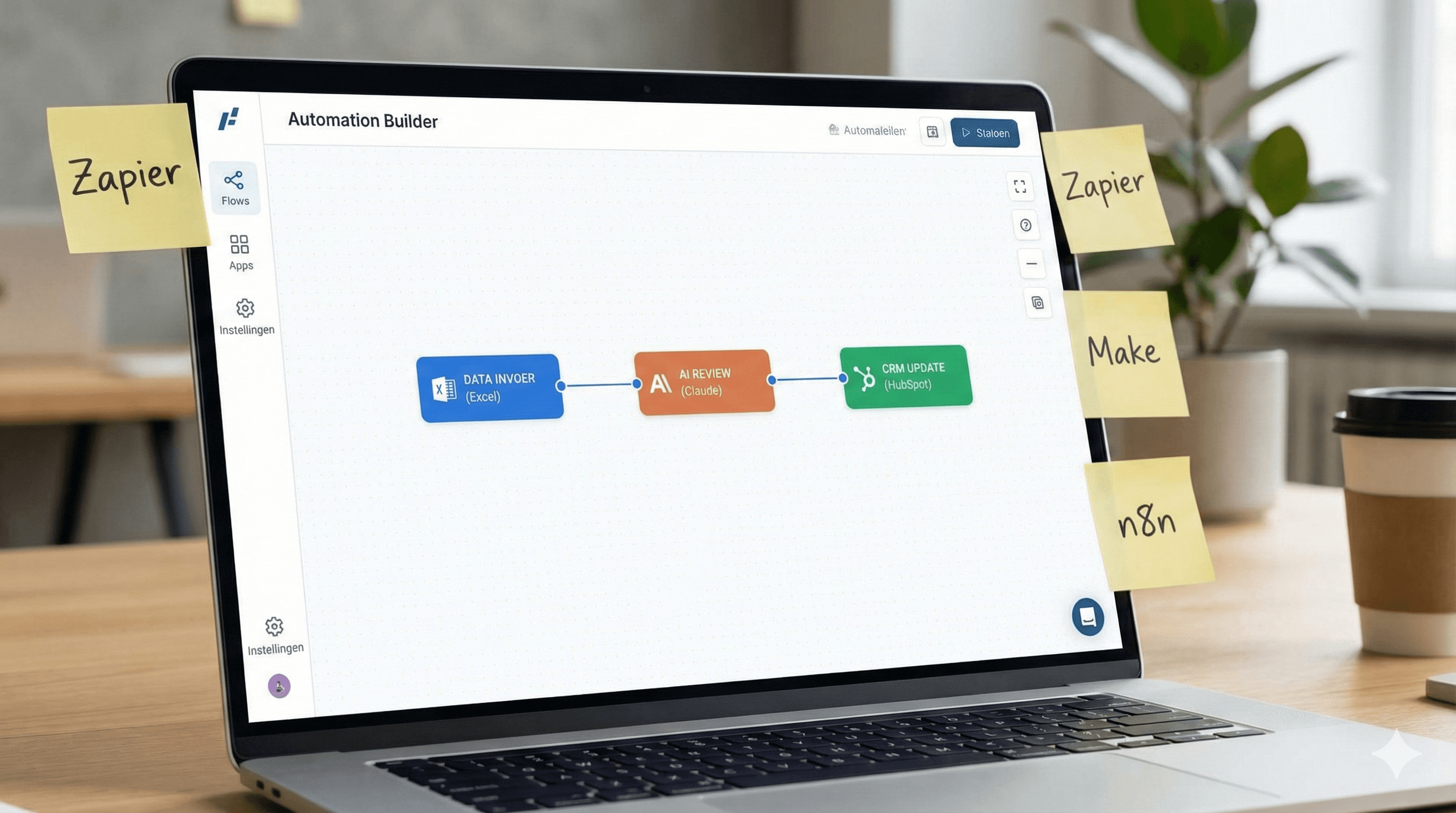
Core message: AI agents aren't chatbots. They execute multiple steps, integrate with your systems (Exact, AFAS, HubSpot), and run 24/7. Below are five processes SMBs can automate today—with concrete savings and implementation timelines.
Overview: 5 Processes at a Glance
| # | Process | Time Saved | Implementation | Software |
|---|---|---|---|---|
| 1 | Invoicing & payables | 8–12 hours/week | 2–8 weeks | Exact, AFAS, Moneybird |
| 2 | Lead handling & CRM | 5–8 hours/week | 2–6 weeks | HubSpot, Salesforce, Pipedrive |
| 3 | Customer service | 10–15 hours/week | 2–8 weeks | Trengo, Zendesk, WhatsApp |
| 4 | Reporting & data | 4–6 hours/week | 1–6 weeks | Exact, AFAS, Power BI |
| 5 | Appointment scheduling | 3–5 hours/week | 1–5 weeks | Outlook, Google Calendar |
<!-- money-link:Overview: 5 Processes at a Glance -->
From overview to implementation
This article outlines the opportunities; on our AI agents page, you'll see how we concretely automate these processes. Unsure where to start? Begin with AI consultancy or take a free AI scan.
1. Invoicing and Payables Management
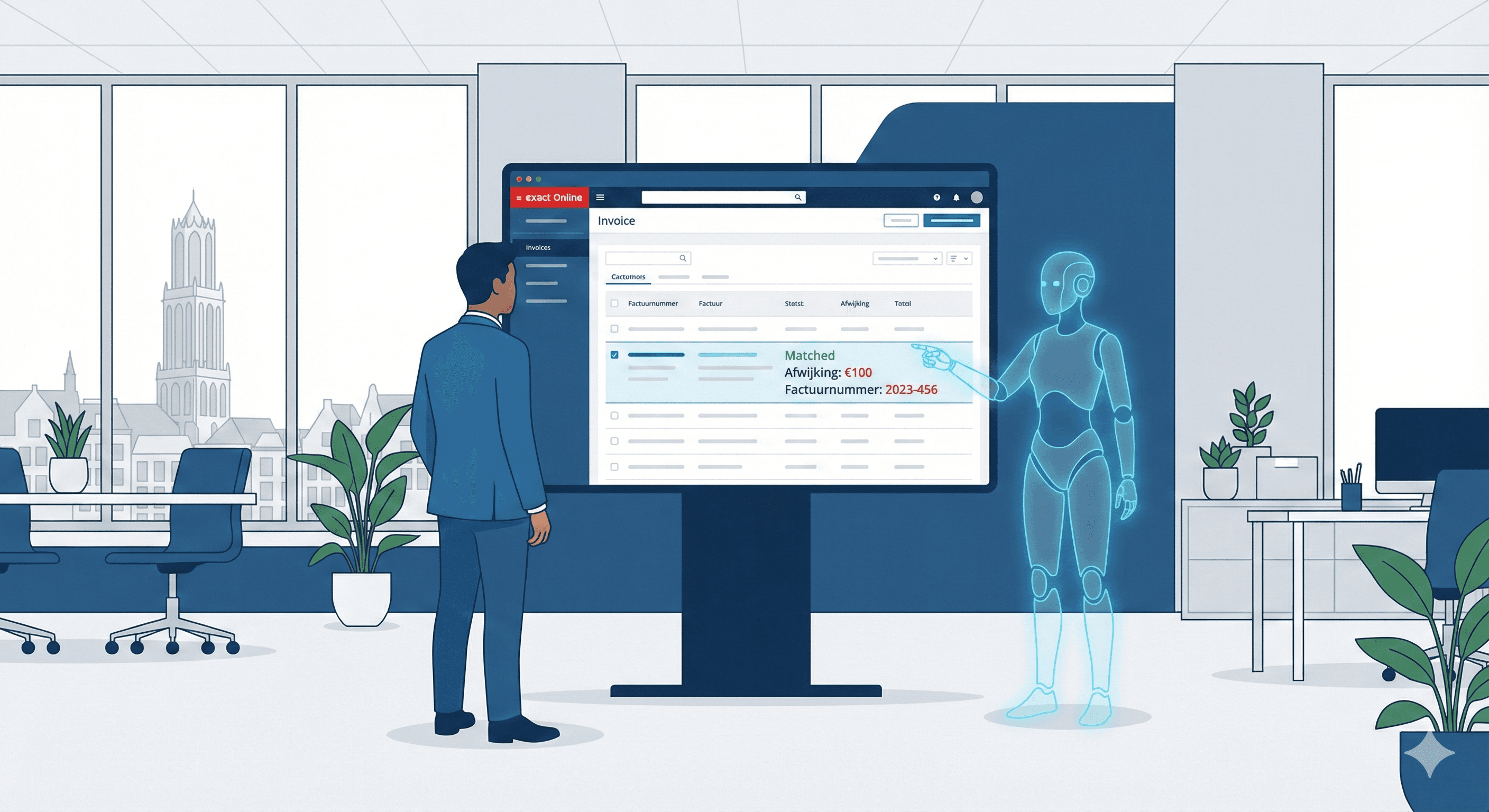
Invoices arrive, need verification, posting, and payment—most SMBs still handle this manually. An AI agent reads invoices in (OCR), matches amounts and suppliers against purchase orders, and executes bookings in your accounting system.
The problem: Invoice processing costs an average of 8–12 hours per week for a mid-sized company. Manual entry errors lead to duplicate payments and time-consuming corrections.
The solution: An AI agent handles non-standard invoice formats, missing data, and exceptions. It decides when to ask for human input.
Result: Companies automating invoicing report 60–70% less manual processing time on average and significantly fewer accounting errors.
Integrations: Exact Online, AFAS, e-Boekhouden, Moneybird. The agent retrieves invoice data, writes to the general ledger or payables module, and prepares payment runs.
Implementation timeline: 2–4 weeks (simple intake and matching); 6–8 weeks (full integration with approval cycles and payments).
2. Lead Handling and CRM Updates
New leads from forms, email, or events need to go into your CRM, be scored, and get quick follow-up. Did you know leads waiting longer than 5 minutes for contact convert 10× worse? Manual entry wastes time and loses customers.
The problem: Manual lead entry and follow-up takes 5–8 hours per week. Meanwhile, opportunities slip away.
The solution: The agent combines multiple steps: read source, map fields, detect duplicates, apply scoring rules, and execute actions in CRM and email—all automatically.
Result: Shorter response times, higher conversion, and a CRM that stays current without manual work.
Integrations: HubSpot, Salesforce, Pipedrive, Microsoft Dynamics, Office 365, Gmail. Often paired with your form or landing-page tool.
Implementation timeline: 2–3 weeks (standard lead intake and routing); 4–6 weeks (with scoring and personalized follow-up actions).
3. Customer Service and First-Line Responses
70% of customer questions are routine: opening hours, order status, return policies, product details. An AI agent answers these from your knowledge base, FAQ, or documents and executes actions when needed (retrieve order status, create returns, open tickets). Complex inquiries go to a team member.
The problem: A team member spending 3 hours daily on routine questions devotes 15 hours per week to work an agent handles in seconds.
The solution: The agent does more than answer: it checks your backoffice, creates tickets, and schedules appointments. That dramatically reduces handoffs and wait times.
Result: SMEs deploying a customer service agent see 40–70% fewer first-line questions for team members on average and can focus on complex cases.
Integrations: Trengo, Zendesk, Freshdesk, HubSpot Service, email, WhatsApp. SME software is increasingly supported.
Implementation timeline: 2–4 weeks (FAQ/knowledge base only); 4–8 weeks (including ticket integration and order/return systems).
4. Reporting and Data Synchronization
Monthly or weekly reports assembled manually from multiple systems—automate with an AI agent. The agent pulls data from ERP, CRM, or accounting, applies fixed formats, flags outliers, and delivers the report via email or dashboard.
The problem: Manual reporting takes 4–8 hours per period and regularly contains copy errors or stale data—exactly when you're making business decisions.
The solution: The agent combines multiple sources, applies calculations, and automatically adds a summary or alert when deviations occur.
Result: Always-current reports without manual effort and faster insight into what needs attention, including automatic outlier alerts.
Integrations: Exact, AFAS, HubSpot, Power BI, Google Sheets. Often via API or automated export the agent orchestrates.
Implementation timeline: 1–3 weeks (single source, fixed format); 4–6 weeks (multiple sources and dynamic interpretation).
5. Appointment Scheduling and Calendar Management
Registrations for intakes, demos, or maintenance must go in your calendar with reminders and intake forms. Every back-and-forth email about an appointment wastes 3–5 minutes. At 20 appointments per week, that's over an hour and a half lost daily.
The problem: Coordinating availability, sending confirmations, and handling changes consumes unnecessary time from your team.
The solution: An AI agent retrieves availability from calendars, books appointments, sends confirmations, and handles changes. It works with complex rules (buffers, multiple locations, different staff) and links directly to the CRM.
Result: Fewer missed appointments, no-shows prevented by automatic reminders, and a fully current CRM without manual entry.
Integrations: Microsoft 365/Outlook, Google Calendar, Calendly. Often linked to CRM for end-to-end lead-appointment integration.
Implementation timeline: 1–2 weeks (simple calendar booking); 3–5 weeks (multi-calendar, reminders, and CRM integration).
Which Process Delivers the Most Value for Your Business?
Start with the process costing the most manual hours where data and systems are reasonably organized. That yields the quickest results and clearest ROI.
Proof from the field: An installation company with 25 employees saved €180,000 annually through automating quotes, scheduling, and administration—with a €15,000 investment. Payback: under 3 months.
Want to know which process brings the most return for your company? Take the free AI scan and we'll tell you within 24 hours which step creates the most value.
Ready to dive deeper into how AI agents work, which integrations we support, or what other companies are achieving? Check our use cases or contact us for a straightforward conversation.
<!-- money-link:Which Process Delivers the Most Value for Your Business? -->
Next step
Ready to tackle one process? Schedule a consultation or request an AI scan—you'll get a prioritized list of quick wins and indicative ROI.
Frequently Asked Questions
What's the difference between an AI agent and a chatbot?
A chatbot answers questions in a conversation. An AI agent actually executes steps: opening systems, reading and writing data, and completing an entire process (e.g., post an invoice, add a lead to CRM). For process automation, that execution role is essential.
Do AI agents work with Dutch software like Exact and AFAS?
Yes. Modern AI agents integrate via APIs with Exact Online, AFAS, HubSpot, Trengo, and other software SMEs use daily. Implementation time depends on available integrations and whether custom work is required.
How long does automating a process with an AI agent take?
It varies by process. Simple tasks (e.g., booking appointments on one calendar) go live in 1–2 weeks. More complex processes (invoicing with approval cycles) take 4–8 weeks. A free AI scan tells you exactly what to expect.
What does automating a business process with an AI agent cost?
Costs vary by process and complexity. A simple integration typically starts around €2,000–€5,000. More complex implementations range €15,000–€50,000. Most companies recover the investment within 3–6 months through labor savings.
Does my company need technical knowledge to get started?
Not at all. We handle implementation; you provide system access and a description of your workflow. During and after implementation, we train your team on how the agent works and how to adjust it.