B2B Lead Generation with AI on LinkedIn: What Works in 2026
 Erwin Berkouwer
AI tools let you prospect more precisely on LinkedIn, automate outreach, and qualify leads. What works, what is "spray and pray", and how do you do it right?
LinkedIn remains the go-to B2B platform for Dutch SMEs — and increasingly for international markets too. But manual prospecting no longer scales, and spam messages don't work. AI offers a middle ground: personalised, focused outreach at scale — without breaching your account limits or alienating prospects.
What AI Concretely Does for You
A well-configured AI flow for LinkedIn lead generation does four things:
1. Prospect Identification Based on Your ICP
Using your Ideal Customer Profile, AI searches for matching companies and contacts. Typical inputs include:
- Company size and industry
- Job titles (DMU: procurement, management, IT, finance)
- Technology stack (visible via tools like BuiltWith or Clearbit)
- Recent triggers (funding rounds, new offices, job postings, expansion)
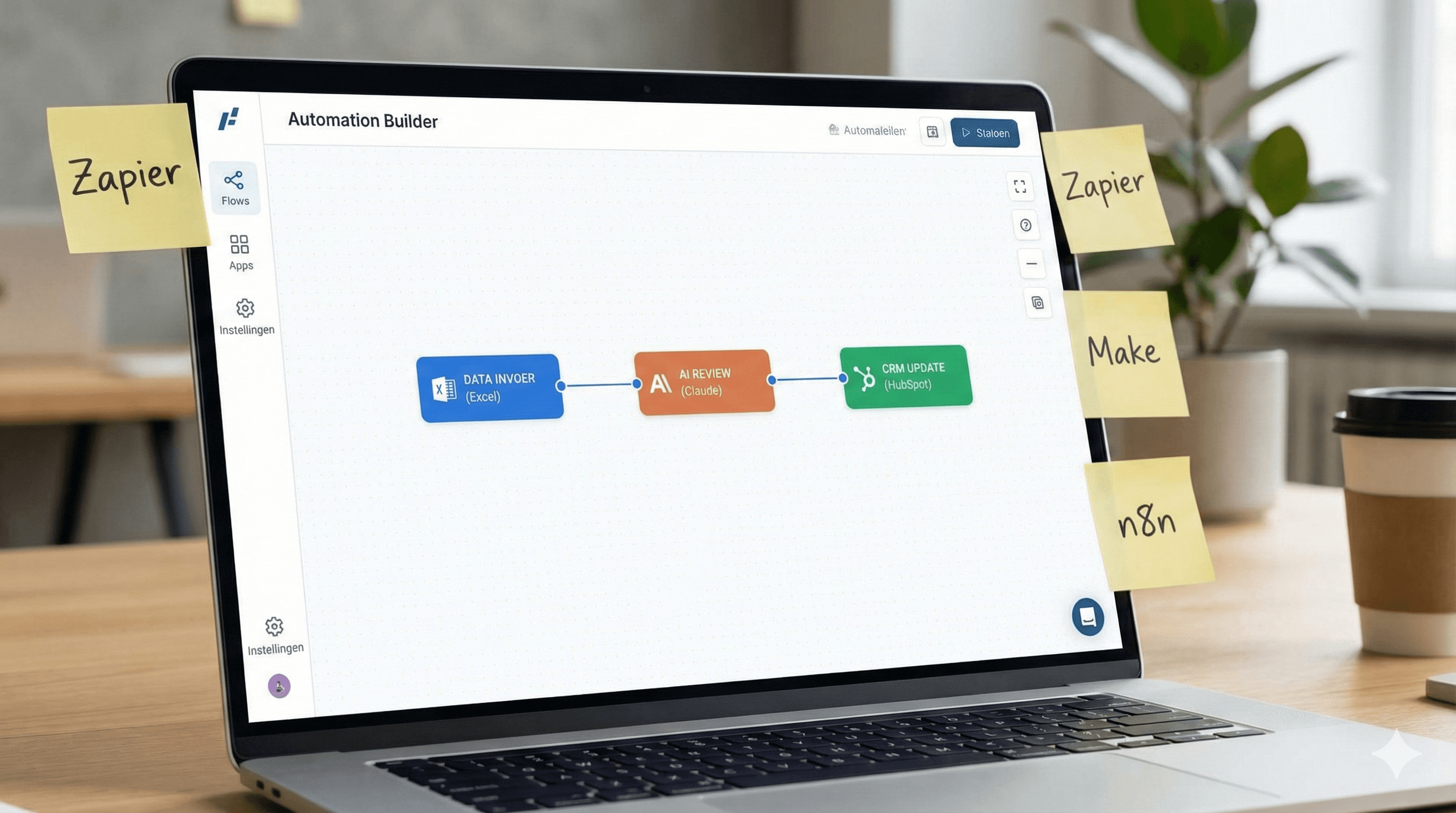
LinkedIn Sales Navigator + AI is the combination of choice here. Sales Navigator filters on company and individual characteristics, while an AI layer (via API or tools like Clay) enriches the list further with contextual data.
2. Personalisation at Scale with Clay and Apollo
Manual personalisation takes 25–40 minutes per prospect. With Clay or Apollo.io, you automatically combine LinkedIn profile data, company news, and recently posted content into a unique message recipe per person. For example:
- "I noticed you recently opened a new office in Manchester — and growth often brings the question of how to scale your sales processes alongside it."
- "Your post last week about AI in finance resonated with me. We help CFOs at mid-sized companies implement exactly that."
Clay connects multiple data sources (LinkedIn, Crunchbase, Clearbit, Apollo) and feeds Claude or GPT-4 with that context to write a personalised opening line per prospect. The result: 3–5 minutes of work per prospect instead of half an hour.
3. Multi-Touch Sequences
AI builds sequences of 4–8 messages over 3–5 weeks, with varying angles:
- Message 1: Connection request without a pitch (relevant context)
- Message 2: Value-first follow-up (insight, case, or question)
- Message 3: Social proof or specific use case
- Message 4: Soft CTA (demo, call, article)
- Messages 5–8: Long-term nurturing for prospects who don't respond immediately
Each message in the sequence is re-personalised based on any profile changes or new posts from the prospect.
4. Qualification and Routing
Responses are analysed and categorised by AI: warm lead, not now, not interested, request for more info. Only genuinely warm leads are passed to sales — the rest stays in nurturing. This saves your sales team hours every week.
Which Tools Work Best in 2026
The most effective stack for SMEs in 2026: LinkedIn Sales Navigator + Clay + Apollo for B2B with an average of 50–200 prospects per week.
- LinkedIn Sales Navigator — prospect identification and filtering on company and individual characteristics (~€100/month)
- Clay — data enrichment and AI personalisation, connects to dozens of data sources (from €149/month)
- Apollo.io — email and LinkedIn sequences, inbox management (from €49/month)
- Lemlist — multi-channel outreach with LinkedIn, email, and video (from €59/month)
- Claude or GPT-4 via API — message copy, qualification, analysis (pay-per-use)
Higher volume? Add Lemlist for inbox rotation and better deliverability.
What WORKS (and Stays Within LinkedIn Guidelines)
- Targeted search lists of no more than 50–100 prospects per week per account
- Deep personalisation based on real profile data — no empty merge tags
- Connect first without a pitch, then offer value in the conversation
- Multi-channel: LinkedIn as the opener, email as the follow-up, phone for warm leads
- A/B testing of opening lines via Clay or Apollo
What Does NOT Work
- Mass invitations without personalisation (LinkedIn throttles and limits your account)
- "Pitch slap" in the first message: a direct sales pitch in the connection request
- AI-generated copy that is obviously AI — prospects spot this immediately
- Tools that scrape or abuse the LinkedIn API — risk of permanent account ban
- Generic templates with only first name and company name as variation
Step-by-Step Plan for SMEs
Weeks 1–2: Define Your ICP Sharply
- Which 3–5 verticals produce your best clients?
- Which job titles make the decision (DMU)?
- Which company size (headcount or revenue)?
- Which recent triggers make your solution urgent?
Weeks 3–4: Build Your Content Library
- 3–5 pain points you offer solutions for
- Cases with concrete results (percentages beat vague claims)
- Insights that demonstrate your expertise (without pitching)
Weeks 5–6: Set Up Tooling and Test
- Connect Sales Navigator to Clay or Apollo
- Write 3 variants of your opening message
- Test with a list of 30 prospects before scaling up
Weeks 7–8: Pilot with 50–100 Prospects
- Track response rate, meeting rate, and deal rate closely
- Iterate on messages and sequences every 2 weeks
- Only scale up once response rate is consistently above 5%
Realistic Results for SME Implementations
For well-configured AI-driven LinkedIn campaigns, we see:
- Response rate: 8–15% (vs. 2–5% for generic outreach)
- Meeting rate: 2–5% of contacted prospects
- Time saving: 3–5 minutes per prospect (vs. 25–40 minutes manually)
- Sales qualification time: −60% because AI pre-sorts on buying intent
Don't expect miracles in the first month. The power lies in consistent execution over 90 days or longer.
GDPR Compliance: What You Need to Know
LinkedIn profile data is publicly available but still falls under GDPR. In practice, this means:
- Process only professional data — no personal information or opinions
- Mention in your outreach where you found someone's details (LinkedIn)
- Respond immediately to opt-out requests and remove the person from your list
- Don't retain contact data longer than your active sales cycle justifies
- When using Clay or Apollo: verify their GDPR compliance and data processing agreement
Tools like Clay and Apollo.io offer standard GDPR compliance features, including suppression lists and automatic opt-out processing. Use them actively.
Three Prerequisites for Success
- Personal account, not a company page: prospects accept people, not company logos
- Strong LinkedIn profile: prospects check your profile before responding — make sure your proposition, social proof, and recent posts are crystal clear
- Avoid tools that violate LinkedIn's terms of service: it may go well briefly, but permanent account bans are catastrophic for your sales engine
Ready to Get Started?
A well-configured AI-driven LinkedIn flow is not an afternoon project — but it is achievable in 6–8 weeks with the right guidance. At UnifyAI, we help SMEs with the complete setup: from ICP definition to live sequences with measurable results.
Get in touch for a free strategy call or read more about our AI consultancy approach.