ChatGPT vs Claude vs Gemini: Which AI Fits Your Business?
 Erwin Berkouwer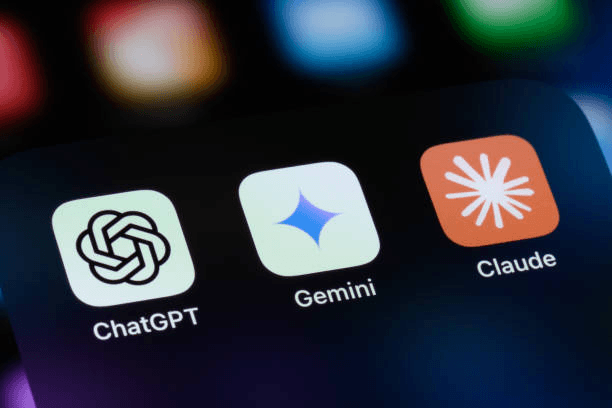
ChatGPT, Claude, and Gemini seem interchangeable — but they're not. Choosing wrong costs you 3 to 6 months. This article compares the three AI tools on security, integrations, price, and SMB suitability, helping you make the right decision.
Picking the wrong AI costs you 3 to 6 months. Not just in money — but in frustrated employees, failed experiments, and lost trust in AI. ChatGPT, Claude, and Gemini seem interchangeable, but they're not. Each model has strengths and weaknesses that determine whether it fits your business and processes.
Why AI Choice Isn't Trivial for Companies
You're not just choosing a tool — you're choosing a working method for the coming years. AI integrates into processes, trains your team, and shapes how your organization works two years from now. A wrong choice is hard to reverse: employees who get used to ChatGPT don't want to switch to Claude, and vice versa.
Three factors make the choice complex for SMBs:
- Security: not all plans are GDPR-proof for business data
- Integrations: which tool works seamlessly in your existing workflow?
- Costs: free versions are dangerous for sensitive data — what are the real business costs?
If you don't make a conscious choice now, you'll make an expensive one later.
ChatGPT — Strengths, Weaknesses, Best Use Cases
Strengths:
- Best all-rounder for content, marketing, and creative work
- Huge ecosystem: more than 1,000 plug-ins and integrations via GPT Store
- Most recognizable for employees — lowest resistance to adoption
- Strong for brainstorming, customer communication, and quote writing
Weaknesses:
- Less capable with long documents (128K context window vs 200K in Claude)
- Higher risk of confident but incorrect analyses in complex tasks
- Data storage by default in the US on lower plans
Best Use Cases for Businesses:
- Marketing agencies: ad copy, social media, email campaigns
- Sales teams: quotes, follow-up messages, customer presentations
- HR departments: job postings, onboarding content, job descriptions
Claude — Strengths, Weaknesses, Best Use Cases
Strengths:
- Best model for long documents and in-depth analysis (200K context window)
- Most accurate output with complex instructions
- Lowest hallucination rate — crucial for legal or financial text
- Excellent for coding and technical documentation
Weaknesses:
- Less creative than ChatGPT for marketing copy
- Smaller plug-in library and fewer ready-made integrations
- Slightly steeper learning curve for non-technical users
Best Use Cases for Businesses:
- Accountants and advisors: contract analysis, financial statements, long reports
- IT companies: code review, technical documentation, system analysis
- Legal and medical sector: precision text where errors are costly
Check our AI agents page for examples of how companies use Claude as a specialized agent for recurring analysis tasks.
Gemini — Strengths, Weaknesses, Best Use Cases
Strengths:
- Native integration in Google Workspace: Gmail, Docs, Sheets, and Meet
- Largest context window: more than 1 million tokens — ideal for huge datasets
- No extra tool needed if you already use Google
- Falls under existing Google processing agreement — GDPR advantage
Weaknesses:
- Less capable outside the Google ecosystem
- Writing quality slightly below ChatGPT and Claude for creative tasks
- Less fine-tuned to Dutch language
Best Use Cases for Businesses:
- Teams on Google Workspace: inbox processing, meeting notes, Sheets analysis
- Logistics and operations: analyzing large data files
- Companies with strict GDPR requirements: everything stays within existing Google processing
Comparison Table: Security, Integrations, Price, and SMB Suitability
| Criterion | ChatGPT | Claude | Gemini |
|---|---|---|---|
| Price (business) | €25/user/month | €25/user/month | Included in Workspace |
| Data not used for training | ✅ Team/Enterprise | ✅ Team/Enterprise | ✅ Workspace |
| GDPR compliance | Processing agreement required | Processing agreement required | Via Google Workspace |
| Google Workspace integration | Via plug-in | Limited | ✅ Native |
| Microsoft 365 integration | ✅ Via Copilot | Limited | Limited |
| Context window | 128K tokens | 200K tokens | 1M+ tokens |
| SMB suitability | ⭐⭐⭐⭐⭐ | ⭐⭐⭐⭐ | ⭐⭐⭐⭐ (with Google) |
| Learning curve | Low | Medium | Low (with Google) |
Which AI to Choose When? — Decision Matrix
Choose ChatGPT if:
- You primarily want to automate content, marketing, or customer communication
- Your team has little technical experience and needs to get started quickly
- You want integrations with external tools: Zapier, Make, CRM systems
Choose Claude if:
- You work with long or complex documents requiring careful analysis
- Accuracy is crucial: legal, financial, or medical context
- You want to build an AI agent that works consistently and reliably
Choose Gemini if:
- Your organization already runs on Google Workspace
- You want GDPR compliance to be simple via existing Google agreement
- You need to process large datasets without context limitations
The smartest strategy for most SMBs: start with ChatGPT Team for broad adoption. Add Claude for specific analysis tasks. Use Gemini if you already run on Google — it costs you nothing extra.
Want to know which integrations are possible with your existing business software? Or check our use cases for concrete examples from your industry.
Frequently Asked Questions
Which AI is safest for business data?
All three offer business plans where your data isn't used for model training. Claude and ChatGPT require a separate processing agreement for GDPR compliance. Gemini automatically falls under your existing Google processing agreement, making it administratively the simplest. Never use a free plan for sensitive business data.
Can I use multiple AI models at the same time?
Yes, and for most companies that's the smartest strategy. ChatGPT for content and communication, Claude for in-depth analysis, Gemini for your Google Workspace workflow. Costs stay manageable: €40–50 per employee per month gives access to two tools and delivers 5–10 hours time savings per week.
Which AI has the lowest learning curve for non-technical employees?
ChatGPT has the lowest learning curve and most intuitive interface — ideal for first-time AI adoption in your team. Gemini is easiest if you already use Google tools, since it just appears in Gmail and Docs. Claude requires a bit more prompting knowledge but delivers the most reliable output for complex tasks.
What does choosing the wrong AI cost a company?
Direct costs are limited: €20–25 per month per user. The real costs are in failed implementations, frustrated employees reverting to old workflows, and lost competitive advantage. Companies that experiment haphazardly lose an average of 3–6 months before finding a working approach.
How Does ChatGPT Team Differ from ChatGPT Enterprise?
ChatGPT Team (€25/user/month) offers privacy guarantees and team collaboration. Enterprise adds extensive admin controls, SSO (Single Sign-On), higher usage limits, and dedicated support. For SMBs up to 50 employees, Team is usually sufficient. Enterprise becomes interesting with strict compliance requirements or when rolling out AI broadly in your organization.
UnifyAI helps you choose the right AI and implement it. We assess which model fits your workflows, handle GDPR documentation, and guide your team through first steps — so you don't waste 6 months experimenting. Schedule a free conversation or see how we implement AI at SMEs.