Why 70% of AI Implementations Fail in SMEs (And How to Avoid It)
 Erwin Berkouwer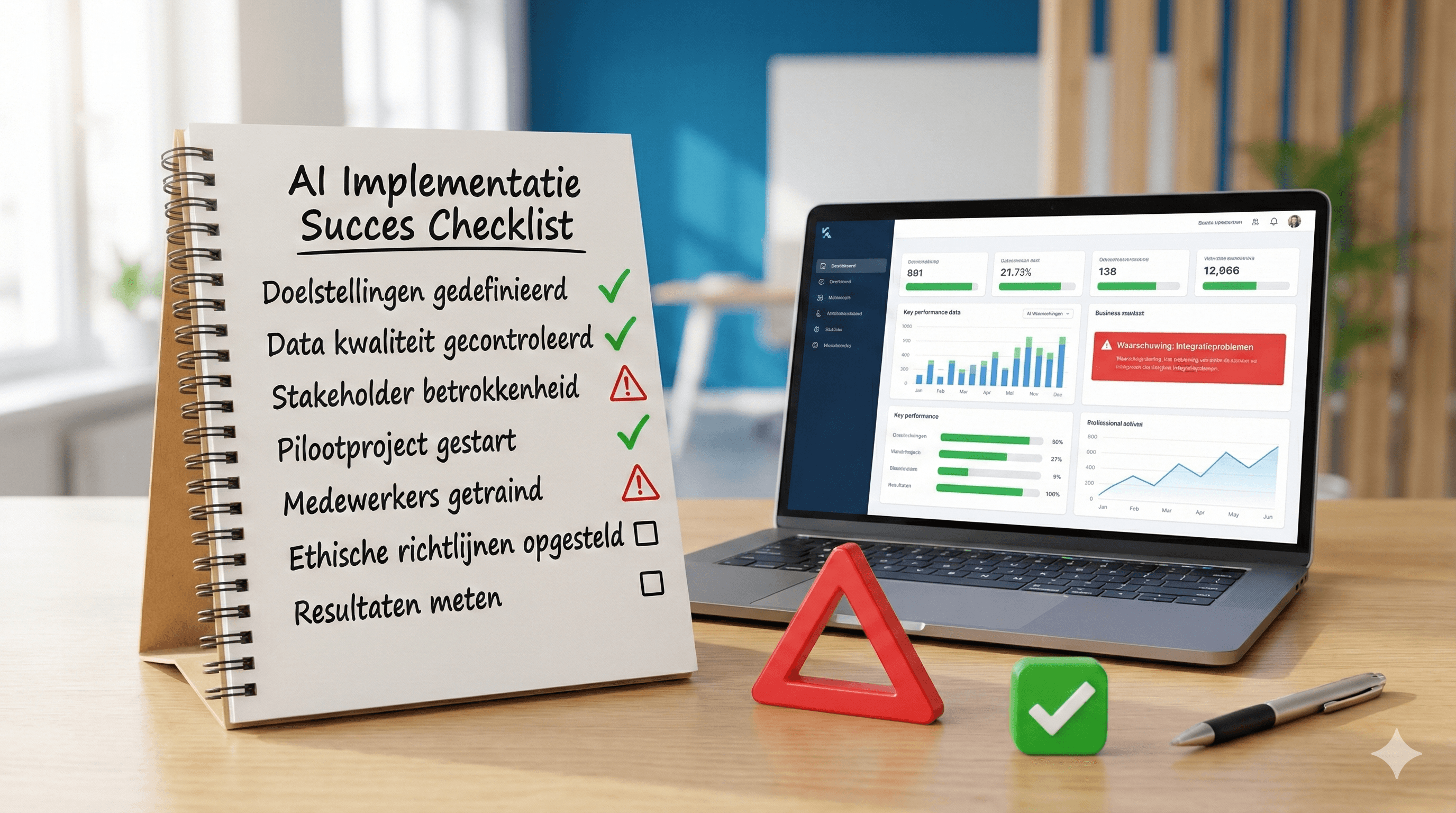
Seven out of ten businesses fail to achieve expected results in AI implementation. Here are the four predictable mistakes and how to avoid them.
Every month that your competitor automates invoice processing, has AI answer customer service questions, and optimizes inventory planning — while you're still figuring it out — the gap grows wider. Yet caution is not unreasonable: 7 out of 10 AI implementations in SMEs fail to deliver expected results. A wrong approach costs you an average of €30,000–80,000 and six to twelve months of lost time.
Good news: the causes are predictable. And predictable mistakes are avoidable.
Why Do So Many AI Implementations Fail?
According to NTT DATA (2024), 70–85% of generative AI implementations fail to achieve the desired ROI. Gartner predicts that organizations will stop 60% of their AI projects by 2026 due to lack of AI-ready data. MIT research (2024) shows that 58% of projects encounter unexpected data quality problems that delay or derail implementation.
In the Netherlands, only 23% of SME companies with 10+ employees used AI structurally in 2024 — but a significant portion of that group reports disappointing results. Not because AI doesn't work, but because the approach was wrong.
There are four predictable causes that keep coming up.
Mistake 1: No Clear Problem Defined
"We want to do something with AI" is not a strategy. Companies that start without a specific, measurable goal — what problem are we solving, for whom, how do we measure success after 90 days? — end up with a proof-of-concept that never reaches production.
What this costs you: An average of 3–6 months in implementation time and €15,000–40,000 in implementation costs for a project that stalls.
Expert tip: Frame your goal as a business problem, not a technology choice. "We want to use AI" is wrong. "We want to reduce invoice processing from 4 hours to 30 minutes per week" is correct.
The solution: Start with one specific process that occurs regularly (at least weekly), costs many manual hours, and has measurable output — time, cost, or error percentage.
Mistake 2: Data Not in Order
AI runs on data. If your customer data is in three different systems, invoices are entered manually, and there's no unified product catalog, no AI tool can simply fix that. Garbage in, garbage out.
Gartner's 2025 analysis shows that 42% of failed AI projects cite "unclear business value" as the primary cause — but the underlying problem is almost always data: not enough, not clean, not accessible.
| Data Situation | What It Means | Action Required |
|---|---|---|
| Data in one system, structured | AI-ready | Start immediately |
| Data in multiple systems, inconsistent | Preparation needed | 4–8 weeks of data cleanup |
| Data manual, barely digitized | Fundamental step needed | Digitize first |
| No historical data (<6 months) | AI has insufficient input | Pilot with external dataset |
The solution: Conduct a data quality scan before you evaluate tools. The UnifyAI integrations — with Exact Online, AFAS, and HubSpot — are specifically designed to bring dispersed data together without a major IT project.
Mistake 3: Employees Not Brought Along
70.9% of SMEs cite lack of expertise as the biggest barrier to AI adoption. But expertise isn't bought — it's built. If employees don't understand why AI is being deployed and how to work with it, they won't use it or will use it incorrectly.
McKinsey (2024) calculated that companies investing in cultural change have 5.3× higher success rates than companies focusing only on technology.
Expert tip: Assign an internal "AI owner" for each implementation — an employee who works with the system daily, is responsible for results, and guides colleagues. No owner = no adoption.
The solution: Involve the employees who will use the system before you choose tools. Their resistance or enthusiasm is the most reliable indicator of success — not the vendor's demo.
Mistake 4: Starting Too Big
Taking on a complete AI transformation all at once is almost always a recipe for failure. The retailer who invested €80,000 in an AI system for inventory optimization and wasn't live eight months later? Classic case: too big, too little focus, no owner assigned.
The contrast: A transport company in South Holland started with one dispatcher, one region, and one week of historical route data. After six weeks: a working pilot with 12% fuel savings. Then scaled to the entire fleet.
Expert tip: Apply the 90-day rule: if a pilot doesn't deliver measurable results within 90 days, the goal is too vague or the scope is too large. Stop then — before you invest more.
Failed vs. Successful AI Projects: The Difference
| Factor | Failed Project | Successful Project |
|---|---|---|
| Goal | "We want to do something with AI" | Specific business problem defined |
| Scope | Entire organization at once | One process, one department |
| Data | Dispersed, manual, unstructured | Centralized, structured, accessible |
| Ownership | IT project without business owner | Business owner + IT as executor |
| Employees | Announcement after implementation | Involved in choice and design |
| Success Measurement | Vague KPIs | Concrete checkpoint after 30/60/90 days |
| Budget | €50,000+ for large system | €5,000–15,000 for targeted pilot |
What Does a Successful Approach Look Like?
Companies that do implement AI successfully follow a recognizable pattern. Check the UnifyAI use cases for concrete examples per sector.
The common pattern:
- One specific pain point as the starting point — not the entire organization
- Data inventory before tool selection — know what you have
- AI agent or workflow that supports the process, doesn't replace it
- 6–8 week pilot with one measurable result
- Scale after proof — not after assumption
The AI agents at Unify are specifically built for SME processes: customer service, document processing, planning support, and lead follow-up. Not generic chatbots, but targeted automation that integrates with your existing systems.
Your Checklist Before You Start
Answer honestly before you invest:
- What specific problem are we solving?
- Do we have sufficient clean, accessible data?
- Is there an internal owner assigned who's responsible for results?
- Are the employees who will use it involved in the choice?
- What's the measurable result after 90 days?
- Does the scope fit within a maximum €15,000 pilot?
If you can't answer three or more questions, it's too early to invest. Not sure where your business stands? The AI-ready checklist for SMEs helps you map that out.
Frequently Asked Questions
Why do so many AI projects fail in SMEs?
Most failures trace back to four causes: no clear goal, disorganized data, employees not brought along, and starting too big. Technology is rarely the problem.
How long does a successful AI implementation take in an SME?
A first working pilot is typically achievable in 6–8 weeks. Full adoption within a department takes an average of 3–6 months.
How much should I invest in AI for my business?
Targeted implementations for one process start at €5,000–15,000. Payback time is typically 3–6 months if the goal is clear and data is in order.
Does my business need technical knowledge to implement AI?
Not necessarily. Many AI tools are plug-and-play. For custom work, you need a partner who understands the technology and knows your business process.
What if my AI project isn't going well now?
Stop, evaluate, and restart with a narrower scope. A failed pilot isn't a failure — it's information. Use it to make a better second attempt with clearer goals and more focus.
Want to know if your business is ready for AI — and what step makes sense first?
Schedule a free 30-minute strategy call. No sales pitch, no one-size-fits-all solution. Just honest advice on what works for your situation.
Want to know which AI step makes sense first? Start with an AI Scan — in 10 minutes you'll know where the quick wins are.